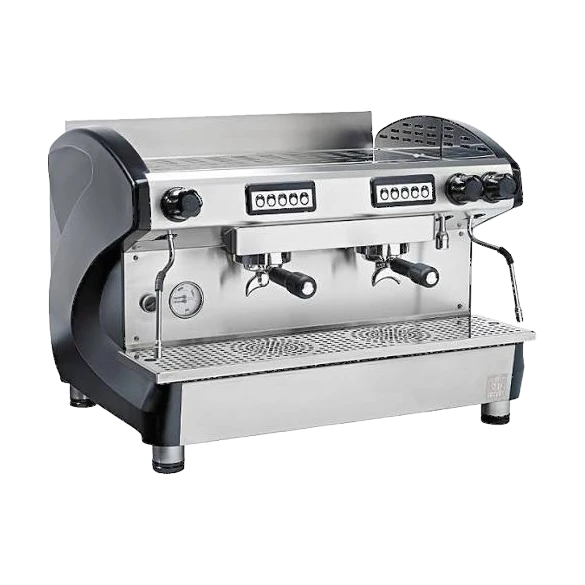
Why are shots from our QEM suddenly weak and fast?
A scaled dispersion screen or brew pressure off its mark, and both are quick to test. The screen gets pulled, soaked in cafiza or replaced if dimpled, and pressure gets measured at the portafilter with the OPV reset to 9 bar if it has wandered. One visit, both causes covered.
Does the QEM have the same injection block as other Renekas?
Yes, the thermoregulated injection path is core Reneka engineering and the QEM carries it. When scale or sensor drift reaches the block, brew temperature shifts while the boiler reads normal. We descale the block, test the sensor, and recalibrate; it's a fault generalist shops routinely misdiagnose as a boiler problem.
What does erratic steam pressure on a QEM point to?
The pressurestat, most often: with age the cut-in and cut-out points wander or the differential collapses. We test against the boiler gauge, adjust the setpoint, and replace the unit if it won't hold. Scale on the steam side gets dealt with in the same visit, since it accelerates the wear.
My QEM's low-water alarm comes on with a full tank. Why?
Classic scaled level probe; it stops conducting and the controller assumes empty. We pull and descale or replace the probe and verify the autofill so the alarm stays quiet. It's the most common nuisance fault on machines fed unsoftened water.
Can you reprogram the volumetric doses on a QEM?
Yes, and we do it by weight rather than by eye. Dose drift means the flow meter's pulse wheel has mineral on it, so cleaning comes first, then each button is reprogrammed against a weighed target. The fix is in the cleaning; the programming just locks it in.
How much daily care does a QEM actually need?
Backflush at close, wipe and purge the steam wand, keep the water filtration honest. That routine keeps gaskets, screens, and the milk side out of trouble and stretches the descale interval. Our techs walk staff through it at the end of a visit; it takes minutes and saves service calls.
Is the QEM expensive to keep running?
No more than any traditional machine; its wear parts are ordinary gaskets, screens, and valve kits. The Reneka-specific pieces, the injection block and the controller, fail rarely and come through the European channel when they do. Most QEM visits are small-money wear work.
Who tends to run the QEM, and does that change the service?
We mostly meet it in hotel lobby bars and boutique restaurants at moderate volume. Lighter duty means slower wear but also longer gaps between professional eyes on the machine, so small faults get time to grow. A periodic check matched to your pour count is the honest middle ground.
How much does a repair visit cost?
Flat rate for the visit, parts billed at their actual cost on top. You'll hear the rate when you book, and for bigger jobs we quote in writing on-site before any work starts. No estimate that balloons mid-job.
How fast can you get here?
Same-day. Call in the morning and a technician is usually on-site before the day is out; calls placed later in the day book for the next morning. Urgent breakdowns get priority routing.
Which areas do you cover?
The GTA and most of the Golden Horseshoe: Toronto through Mississauga, Vaughan, and Markham, out to Oshawa, Hamilton, and Niagara. If you're not sure you're in range, call and we'll tell you straight.
Do I need a service contract?
No. We work call by call. Plenty of customers put us on a maintenance schedule eventually, but that's their choice after seeing the work, never a requirement.
Are the repairs warrantied?
Parts carry their manufacturer warranty, and we stand behind our labour: if the same fault recurs, call us and we'll review it. Specific terms are discussed upfront on each job, not promised in marketing copy.
Do you repair on-site or take the machine away?
On-site whenever possible, which is most of the time. If a job genuinely needs the bench, like a full boiler rebuild or major electronics work, we'll say so before anything leaves your building.
How do I book a service call?
Call us or send the form on this page. We confirm the machine, the fault, and a time window the same day. If it's urgent, say so and we'll route the nearest technician.
What happens on the first visit?
Diagnosis first: we confirm the fault, tell you what caused it, and quote the fix before touching a wrench. Most repairs finish in that same visit because the common wear parts ride on the truck.
Do you carry parts or order them in?
High-wear parts for the platforms we service constantly ride on the truck. Anything else we order, usually next-day where suppliers allow, and we tell you the lead time before committing you to anything.
My machine is older or out of production. Will you still look at it?
Usually, yes. We service legacy machines for as long as parts can be sourced, and we're honest when a repair stops making financial sense against a replacement. You get the math, you make the call.
Are you cheaper than the manufacturer's service network?
Often, but that's not the pitch. We quote against the actual work, not a factory pricing book, and we'll tell you when a manufacturer warranty claim is the better route. Transparency is the value; the price usually follows.
Can you train our staff so this doesn't happen again?
Yes, and we do it by default on the way out. Half of repeat faults trace back to skipped daily cleaning or wrong routine, so the technician walks your team through what actually matters before leaving.