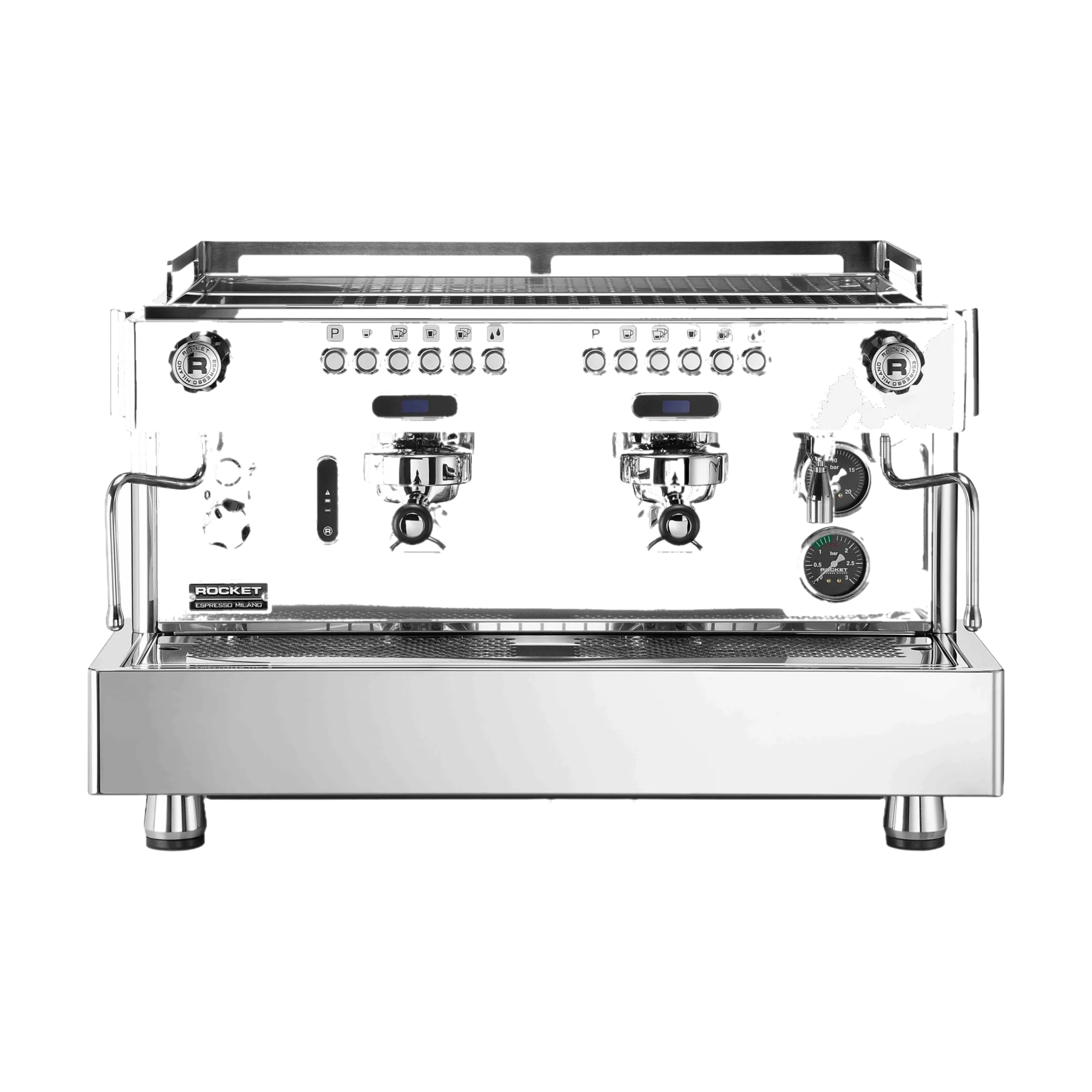
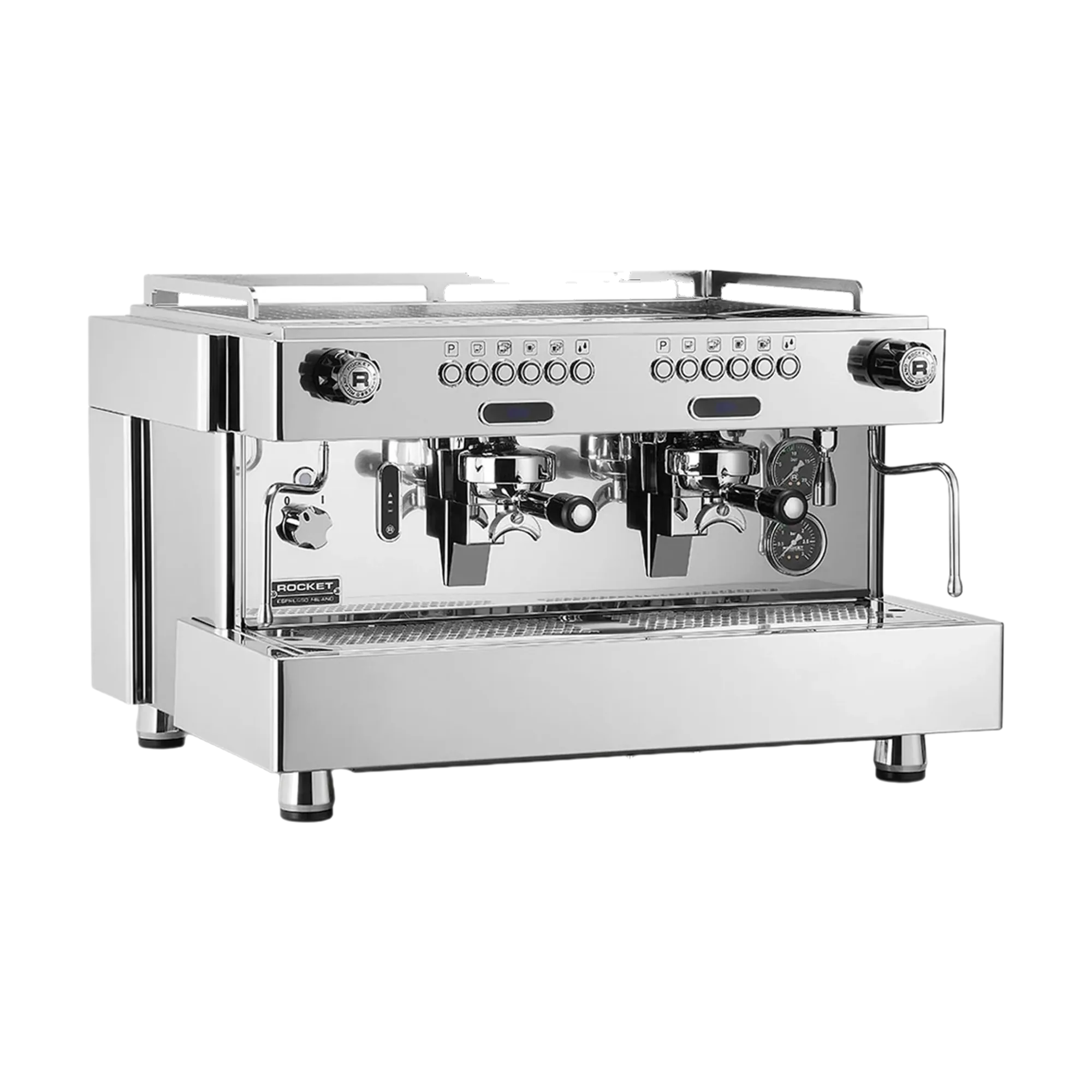
Why is the first shot on my RE A Timer always cold?
That's the thermosiphon loop scaling up, restricting the hot-water circulation that keeps the group at temperature between shots. We descale the brew circuit, flush the loop, and verify with a portafilter probe. It's the most characteristic HX fault there is, and one of the most satisfying to fix.
How long should the RE A Timer take to heat up?
A healthy machine needs a fair stretch to bring 14.5 or 23 litres of water to temperature, so don't panic at a long warm-up by itself. What matters is change: when the machine takes noticeably longer than it used to, scale or a tired element is the reason. We benchmark against spec rather than feel.
What goes wrong with the cool-touch steam wands?
The insulating sleeve that keeps the wand grabbable fatigues with years of heat cycling, then cracks or rattles. We replace the sleeve assembly through the Rocket channel. The steam valve behind it is serviced separately and rarely fails at the same time.
Why did my RE A Timer's dose timing drift?
The electronic timer doses by flow meter pulses, and a scaling meter miscounts. We clean the meter, reprogram each dose against a target volume by weight, and verify across repeated pours. If the meter itself is damaged, it gets replaced first.
Can the brew temperature on an HX machine like this be adjusted?
Yes, within the architecture's rules: brew temperature on an HX follows boiler pressure, which the RE A Timer sets through a digitally adjustable transducer. We set the pressure to land your target brew temperature, verified at the group with a probe. It's less push-button than a PID brew boiler, but it's repeatable once set.
My RE A Timer's steam went weak on both wands. What does that mean?
Both wands weak together points upstream of the wands: boiler-wide scale or a heating element losing output. One wand weak alone is local to that wand's valve and tip. The pattern tells us where to start before we've opened a panel.
Is replacing the pump on an RE A Timer a big job?
It's straightforward for someone who does it regularly: the rotary pump and motor are accessible, and we set the OPV as a matched pair with the new pump. Plan for the machine being down for the visit, not for days. Pressure is verified at the group before we leave.
Is an HX machine like the RE A Timer cheaper to keep running than a dual-boiler?
Generally yes. One boiler means one set of scale problems, fewer sensors, and a fault list technicians have known for decades. The trade is less independent temperature control, which is exactly the simplicity many restaurants want. Service costs tend to be the lowest of Rocket's bigger machines.
Can the pressure transducer be recalibrated instead of replaced?
Usually, yes. Most drift is scale at the sensing port, and cleaning plus recalibration brings the reading back honest. We only replace the transducer when drift returns after a clean calibration, which is the minority of cases.
How much does a repair visit cost?
Flat rate for the visit, parts billed at their actual cost on top. You'll hear the rate when you book, and for bigger jobs we quote in writing on-site before any work starts. No estimate that balloons mid-job.
How fast can you get here?
Same-day in most cases. Call in the morning and a technician is usually on-site before the day is out; calls placed later in the day book for the next morning. Urgent breakdowns get priority routing.
Which areas do you cover?
The GTA and most of the Golden Horseshoe: Toronto through Mississauga, Vaughan, and Markham, out to Oshawa, Hamilton, and Niagara. If you're not sure you're in range, call and we'll tell you straight.
Do I need a service contract?
No. We work call by call. Plenty of customers put us on a maintenance schedule eventually, but that's their choice after seeing the work, never a requirement.
Are the repairs warrantied?
Parts carry their manufacturer warranty, and we stand behind our labour: if the same fault recurs, call us and we'll review it. Specific terms are discussed upfront on each job, not promised in marketing copy.
Do you repair on-site or take the machine away?
On-site whenever possible, which is most of the time. If a job genuinely needs the bench, like a full boiler rebuild or major electronics work, we'll say so before anything leaves your building.
How do I book a service call?
Call us or send the form on this page. We confirm the machine, the fault, and a time window the same day. If it's urgent, say so and we'll route the nearest technician.
What happens on the first visit?
Diagnosis first: we confirm the fault, tell you what caused it, and quote the fix before touching a wrench. Most repairs finish in that same visit because the common wear parts ride on the truck.
Do you carry parts or order them in?
High-wear parts for the platforms we service constantly ride on the truck. Anything else we order, usually next-day where suppliers allow, and we tell you the lead time before committing you to anything.
My machine is older or out of production. Will you still look at it?
Usually, yes. We service legacy machines for as long as parts can be sourced, and we're honest when a repair stops making financial sense against a replacement. You get the math, you make the call.
Are you cheaper than the manufacturer's service network?
Often, but that's not the pitch. We quote against the actual work, not a factory pricing book, and we'll tell you when a manufacturer warranty claim is the better route. Transparency is the value; the price usually follows.
Can you train our staff so this doesn't happen again?
Yes, and we do it by default on the way out. Half of repeat faults trace back to skipped daily cleaning or wrong routine, so the technician walks your team through what actually matters before leaving.