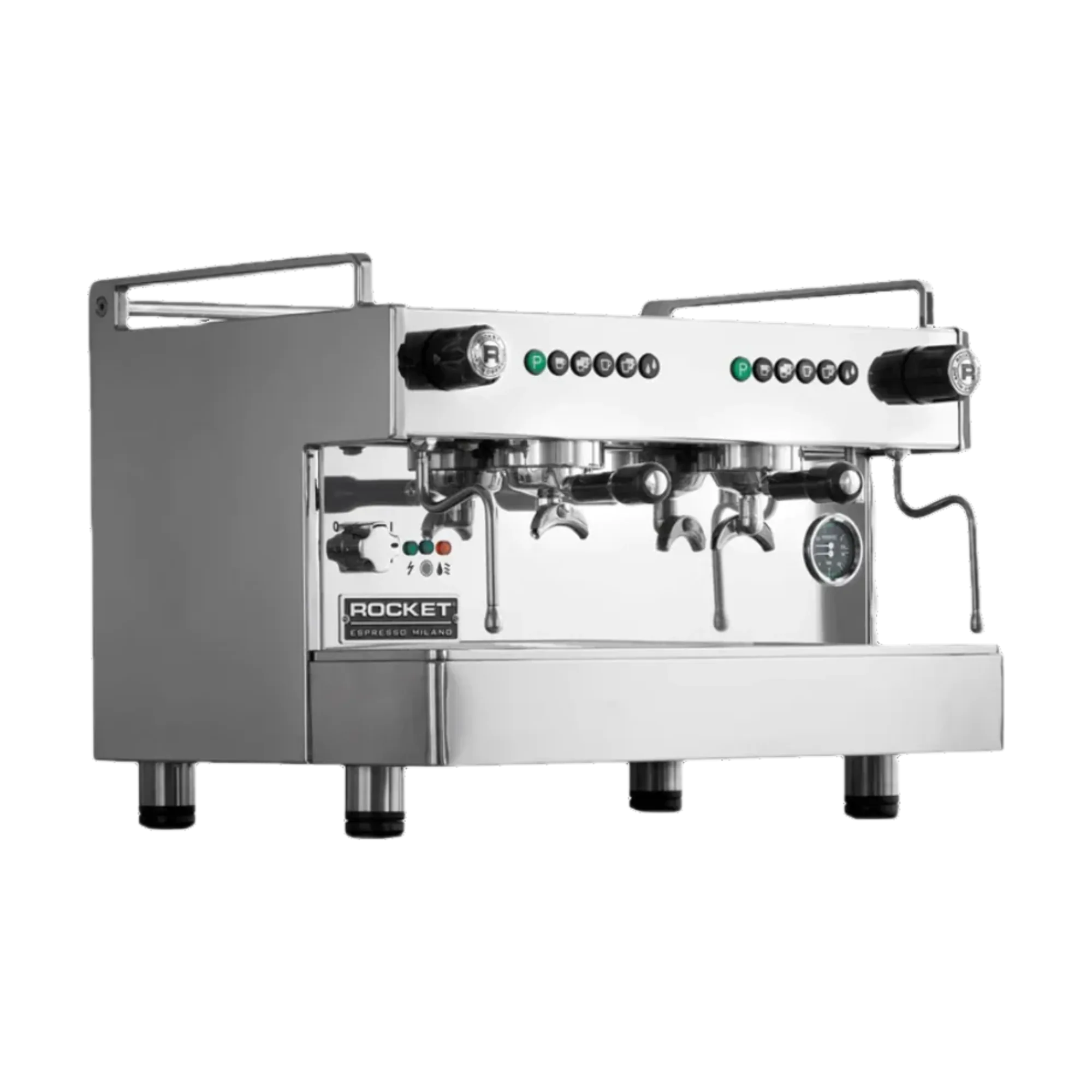
Why is my Rocket Boxer leaking from the group head?
Nine times out of ten it's the group gasket, compressed flat by thousands of portafilter lock-ups. The fix is a Rocket-spec gasket, a cleaned dispersion screen, and a seal verified across test shots. It's routine wear, and one of the fastest repairs on the platform.
Why does my Boxer's steam joystick stick or feel loose?
The joystick assembly wears at its pivot bushing and microvalve seals, and the lever starts catching or drifting back instead of snapping shut. We rebuild the assembly with a new bushing and seals rather than swapping the whole valve. Caught early it's a small job; ignored, it becomes steam that won't shut off.
What does it mean when the Boxer's PID display shows erratic temperatures?
Usually a failing NTC sensor or a corroded connector, not a dead controller. We test the sensor against its resistance table at known temperatures, so the answer is measured rather than guessed. If drift survives a new sensor, then it's the board, and we quote that separately before touching it.
Why is my Boxer's brew pressure low during busy service?
Pressure that holds for one shot but sags under back-to-back extraction points to rotary pump wear or a drifted OPV. We measure at the group with a portafilter gauge, reset the OPV to 9 bar, and replace the pump only if the numbers say so.
How often does a Boxer need descaling on city water?
With a maintained softener, an annual professional descale usually holds the line. Without one, the local water will coat the boiler within months, and you'll see it as slower warm-up and fading steam. The dispersion screens scale on the same schedule, so we do both together.
Can pre-infusion on the Boxer be adjusted or repaired?
Yes. The Boxer's pre-infusion depends on inlet line pressure and brew solenoid timing, both of which we can measure and correct. We log the pressure curve with a portafilter gauge before and after, so you see exactly what changed.
There's water under my Boxer but I can't see where it's coming from. What now?
Hidden leaks on this machine usually come from the boiler manifold, a scale-weakened brass fitting, or the brew solenoid seat. We pressure-test, dry the chassis, and dye-trace until the source shows itself. The failing fitting gets replaced or re-flared, because retightening alone rarely lasts.
Is the Boxer worth repairing after five or more years of cafe duty?
Almost always. The wear items are cheap and the bones (boiler, groups, chassis) are built for a much longer life than five years. The exception is a machine that's run hard water its whole life without treatment; we'll tell you honestly if yours is in that category.
How much does a repair visit cost?
Flat rate for the visit, parts billed at their actual cost on top. You'll hear the rate when you book, and for bigger jobs we quote in writing on-site before any work starts. No estimate that balloons mid-job.
How fast can you get here?
Same-day. Call in the morning and a technician is usually on-site before the day is out; calls placed later in the day book for the next morning. Urgent breakdowns get priority routing.
Which areas do you cover?
The GTA and most of the Golden Horseshoe: Toronto through Mississauga, Vaughan, and Markham, out to Oshawa, Hamilton, and Niagara. If you're not sure you're in range, call and we'll tell you straight.
Do I need a service contract?
No. We work call by call. Plenty of customers put us on a maintenance schedule eventually, but that's their choice after seeing the work, never a requirement.
Are the repairs warrantied?
Parts carry their manufacturer warranty, and we stand behind our labour: if the same fault recurs, call us and we'll review it. Specific terms are discussed upfront on each job, not promised in marketing copy.
Do you repair on-site or take the machine away?
On-site whenever possible, which is most of the time. If a job genuinely needs the bench, like a full boiler rebuild or major electronics work, we'll say so before anything leaves your building.
How do I book a service call?
Call us or send the form on this page. We confirm the machine, the fault, and a time window the same day. If it's urgent, say so and we'll route the nearest technician.
What happens on the first visit?
Diagnosis first: we confirm the fault, tell you what caused it, and quote the fix before touching a wrench. Most repairs finish in that same visit because the common wear parts ride on the truck.
Do you carry parts or order them in?
High-wear parts for the platforms we service constantly ride on the truck. Anything else we order, usually next-day where suppliers allow, and we tell you the lead time before committing you to anything.
My machine is older or out of production. Will you still look at it?
Usually, yes. We service legacy machines for as long as parts can be sourced, and we're honest when a repair stops making financial sense against a replacement. You get the math, you make the call.
Are you cheaper than the manufacturer's service network?
Often, but that's not the pitch. We quote against the actual work, not a factory pricing book, and we'll tell you when a manufacturer warranty claim is the better route. Transparency is the value; the price usually follows.
Can you train our staff so this doesn't happen again?
Yes, and we do it by default on the way out. Half of repeat faults trace back to skipped daily cleaning or wrong routine, so the technician walks your team through what actually matters before leaving.