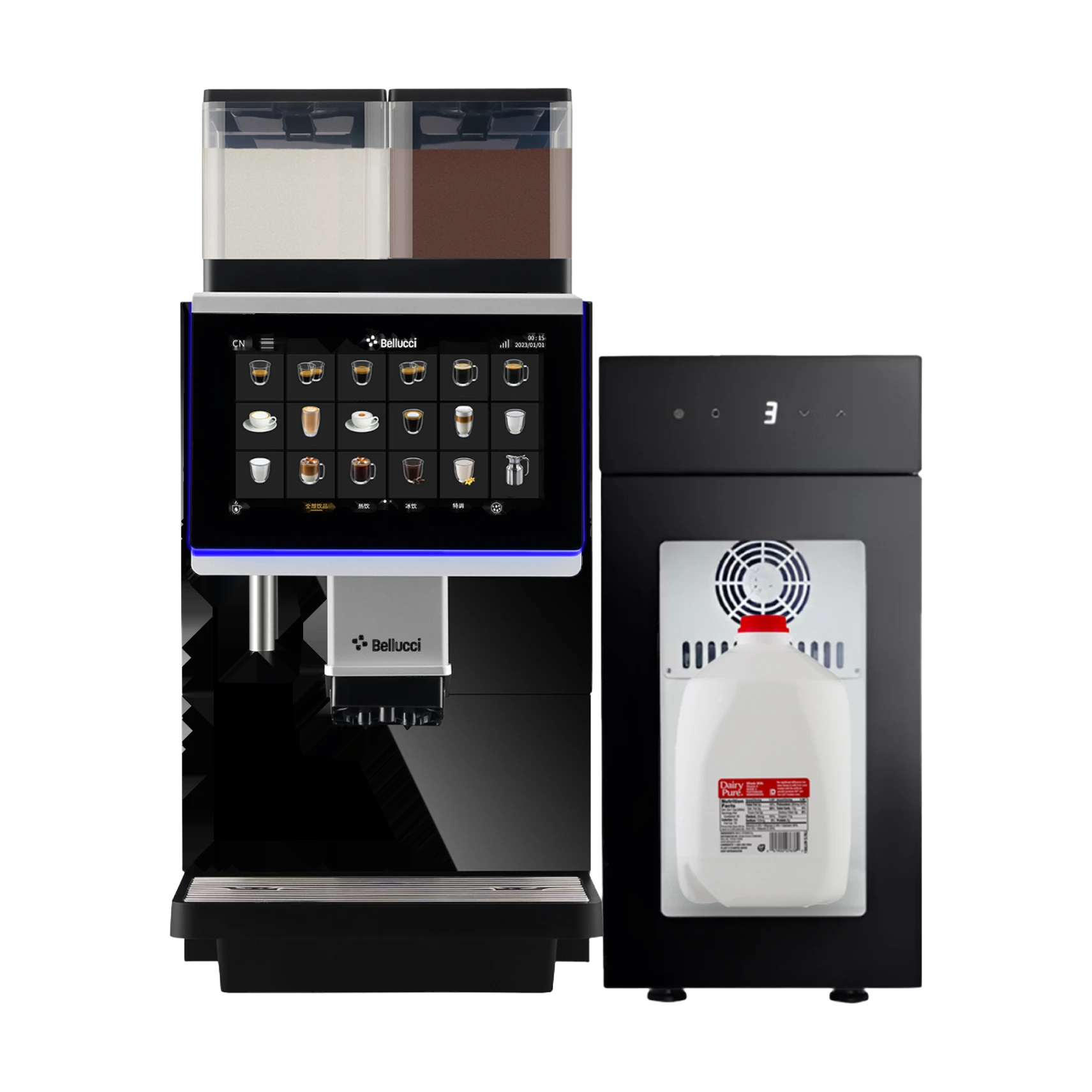
Is the Bellucci Twin Plus a two-group espresso machine?
No, the name misleads: it's a high-volume super-automatic with dual bean capacity, not a dual-group portafilter machine. There are no group gaskets or twin steam wands on it. Service revolves around the brew unit, grinder, milk and soluble circuits, boilers, and touchscreen.
What does a brew unit position fault mean on the Twin Plus?
The automatic brew unit stalled partway through its travel: grounds buildup, worn piston seals, or a weakening drive motor. A single power-cycle is worth trying. Beyond that the assembly needs removal, cleaning, and new wear seals, and we verify the full home-brew-dump cycle before reinstalling.
Why is the Twin Plus showing a heating timeout?
One of the two 1L stainless boilers isn't reaching setpoint in time, almost always from scale or a drifting sensor. We descale the water path, test element resistance and NTC values, and load both boilers with drinks to confirm recovery. It's rarely a terminal fault.
Why does milk foam from the Twin Plus vary cup to cup?
Inconsistency points to protein buildup, a partly blocked air intake, or worn milk seals rather than a broken module. We strip and sanitize the circuit, replace seals and intake parts, and recalibrate the air. At this machine's volume, the cleaning cadence is what keeps foam repeatable.
Why won't the automatic milk clean cycle finish on the Twin Plus?
A blocked cleaning line, a level-sensor fault, or a failed pump interrupts it. We flush the circuit, test the pump, and run the full sanitation cycle through. A machine pouring hundreds of milk drinks a day can't run long with a broken clean cycle, so book it promptly.
Why is powder clumping in the Twin Plus canisters?
Humidity, almost always. Moisture bridges the powder and blocks the chute, and the dosing motor just spins against it. We clear the auger, chute, and mixing path, then look at where the machine lives, because storage conditions cause this more than hardware does.
Can the Twin Plus really do 300 cups a day?
Yes, that's what it's built for, with cleaning cadence and menu mix deciding whether it sustains it. Milk and soluble drinks load the machine far more than straight coffee. Operators who hold the daily routine get the full rating; the fault log tells us quickly when they haven't.
The Twin Plus touchscreen launched the wrong drink. Is it broken?
Probably a contaminated touch surface or a digitizer starting to fail, sometimes just a firmware hang. We reset through service mode, inspect connectors, and recalibrate where supported. The display module only gets replaced once hardware failure is proven.
What should we check before calling about a Twin Plus water fault?
Two things: that the inlet shutoff is fully open, and that nothing visible is leaking under the cabinet. Beyond that, fill faults come from blocked inlet filters, scaled solenoids, or low building pressure, all of which we test on-site. Don't keep power-cycling through a fill error; a pump run dry adds its own repair.
How much does a repair visit cost?
Flat rate for the visit, parts billed at their actual cost on top. You'll hear the rate when you book, and for bigger jobs we quote in writing on-site before any work starts. No estimate that balloons mid-job.
How fast can you get here?
Same-day. Call in the morning and a technician is usually on-site before the day is out; calls placed later in the day book for the next morning. Urgent breakdowns get priority routing.
Which areas do you cover?
The GTA and most of the Golden Horseshoe: Toronto through Mississauga, Vaughan, and Markham, out to Oshawa, Hamilton, and Niagara. If you're not sure you're in range, call and we'll tell you straight.
Do I need a service contract?
No. We work call by call. Plenty of customers put us on a maintenance schedule eventually, but that's their choice after seeing the work, never a requirement.
Are the repairs warrantied?
Parts carry their manufacturer warranty, and we stand behind our labour: if the same fault recurs, call us and we'll review it. Specific terms are discussed upfront on each job, not promised in marketing copy.
Do you repair on-site or take the machine away?
On-site whenever possible, which is most of the time. If a job genuinely needs the bench, like a full boiler rebuild or major electronics work, we'll say so before anything leaves your building.
How do I book a service call?
Call us or send the form on this page. We confirm the machine, the fault, and a time window the same day. If it's urgent, say so and we'll route the nearest technician.
What happens on the first visit?
Diagnosis first: we confirm the fault, tell you what caused it, and quote the fix before touching a wrench. Most repairs finish in that same visit because the common wear parts ride on the truck.
Do you carry parts or order them in?
High-wear parts for the platforms we service constantly ride on the truck. Anything else we order, usually next-day where suppliers allow, and we tell you the lead time before committing you to anything.
My machine is older or out of production. Will you still look at it?
Usually, yes. We service legacy machines for as long as parts can be sourced, and we're honest when a repair stops making financial sense against a replacement. You get the math, you make the call.
Are you cheaper than the manufacturer's service network?
Often, but that's not the pitch. We quote against the actual work, not a factory pricing book, and we'll tell you when a manufacturer warranty claim is the better route. Transparency is the value; the price usually follows.
Can you train our staff so this doesn't happen again?
Yes, and we do it by default on the way out. Half of repeat faults trace back to skipped daily cleaning or wrong routine, so the technician walks your team through what actually matters before leaving.