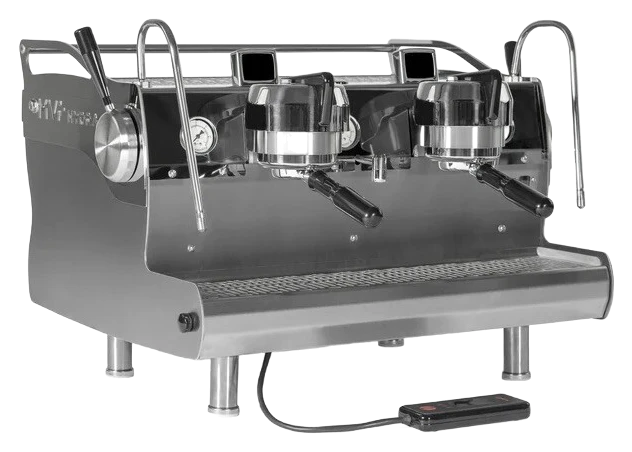
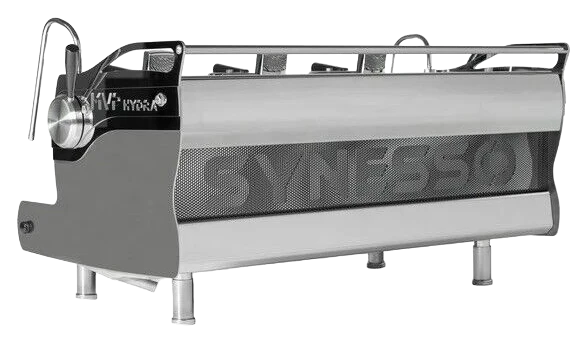
Why is one group on my MVP Hydra pulling at a different pressure?
The MVP Hydra runs a separate rotary pump per group, so one group off-pressure points at that pump or its expansion valve. We gauge every group at the portafilter to isolate the failing unit, then rebuild or replace the pump head. The other groups keep serving while we work.
Why is my MVP Hydra leaking from the group head?
Nine times out of ten it's the T-ring, the proprietary seal between the saturated group and its boiler. Steam venting off the group body or water tracking down the casting is the giveaway. We pull the group, fit a genuine T-ring, torque the bolts in the documented sequence, and pressure-test before the machine goes back into service.
Why has pre-infusion gone flat on one group of my MVP Hydra?
Each group has its own electronically controlled pre-infusion solenoid, and they fail one at a time. We test actuation with a scope, check the controller signal, and replace whichever has died. The curve is then logged against your reference profile so the shot starts the way your baristas dialled it.
One brew boiler on my MVP Hydra runs cold. Is that a big repair?
Usually not. Each group's boiler has its own NTC sensor, PID, and element, and a single cold group almost always traces to one of those three. Sensor swaps and PID recalibrations are quick; even an element replacement is routine. The fault never spreads to the other groups.
Why does my MVP Hydra lose steam pressure during rush?
The dedicated steam boiler is recovering constantly under a milk-heavy rush, and scale, a drifting pressurestat, or a tired element will show up exactly then. We descale, test the pressurestat at setpoint, and measure element resistance to find the weak link. Most steam complaints resolve in one visit.
Will you preserve our pressure profiles after a repair?
Yes, that's part of the job. Any repair that touches temperature, pressure, or pre-infusion ends with the affected group re-verified against your house profile, and we pull calibration shots with your head barista where they want them. The machine leaves our hands on your settings, not factory defaults.
How often do MVP Hydra T-rings need replacing?
It depends on volume, but on a busy bar think in terms of regular wear, not a one-off failure. Groups that see the most action wear their seals first, so we inspect the others whenever we replace one. Catching a softening T-ring early is far cheaper than a mid-service leak.
Is an MVP Hydra worth repairing, or should we replace it?
Almost always worth repairing. The machine is a serious capital purchase and the multi-boiler core ages slowly; what fails is the affordable ring of wear parts around it. We quote the repair and give you an honest read on remaining life, and the math nearly always lands on repair.
The display on our MVP Hydra is dead. Can it be fixed on-site?
Usually, yes. Ribbon connectors and membrane buttons fail more often than the board itself, and we diagnose down to the exact layer before quoting. Boards and keypads come through Middleby's Synesso parts network, generally within the week.
How much does a repair visit cost?
Flat rate for the visit, parts billed at their actual cost on top. You'll hear the rate when you book, and for bigger jobs we quote in writing on-site before any work starts. No estimate that balloons mid-job.
How fast can you get here?
Same-day. Call in the morning and a technician is usually on-site before the day is out; calls placed later in the day book for the next morning. Urgent breakdowns get priority routing.
Which areas do you cover?
The GTA and most of the Golden Horseshoe: Toronto through Mississauga, Vaughan, and Markham, out to Oshawa, Hamilton, and Niagara. If you're not sure you're in range, call and we'll tell you straight.
Do I need a service contract?
No. We work call by call. Plenty of customers put us on a maintenance schedule eventually, but that's their choice after seeing the work, never a requirement.
Are the repairs warrantied?
Parts carry their manufacturer warranty, and we stand behind our labour: if the same fault recurs, call us and we'll review it. Specific terms are discussed upfront on each job, not promised in marketing copy.
Do you repair on-site or take the machine away?
On-site whenever possible, which is most of the time. If a job genuinely needs the bench, like a full boiler rebuild or major electronics work, we'll say so before anything leaves your building.
How do I book a service call?
Call us or send the form on this page. We confirm the machine, the fault, and a time window the same day. If it's urgent, say so and we'll route the nearest technician.
What happens on the first visit?
Diagnosis first: we confirm the fault, tell you what caused it, and quote the fix before touching a wrench. Most repairs finish in that same visit because the common wear parts ride on the truck.
Do you carry parts or order them in?
High-wear parts for the platforms we service constantly ride on the truck. Anything else we order, usually next-day where suppliers allow, and we tell you the lead time before committing you to anything.
My machine is older or out of production. Will you still look at it?
Usually, yes. We service legacy machines for as long as parts can be sourced, and we're honest when a repair stops making financial sense against a replacement. You get the math, you make the call.
Are you cheaper than the manufacturer's service network?
Often, but that's not the pitch. We quote against the actual work, not a factory pricing book, and we'll tell you when a manufacturer warranty claim is the better route. Transparency is the value; the price usually follows.
Can you train our staff so this doesn't happen again?
Yes, and we do it by default on the way out. Half of repeat faults trace back to skipped daily cleaning or wrong routine, so the technician walks your team through what actually matters before leaving.