Coffee equipment glossary
The language of your machine, in plain English.
A plain-English glossary of 213 coffee and espresso machine terms, written by the technicians who repair these machines across the GTA. Search a term, or browse the full A-Z below.
A
- Airpot and satellite server Batch & filter brewing
- The insulated dispensers a batch brewer fills: pump-top airpots for self-serve, and larger machine-docked satellite or shuttle servers for high volume. Both keep coffee hot for hours without a warming plate, which stews coffee. Worn pump lids, broken level gauges, and stale-coffee complaints from oversized batches are the usual issues, and right-sizing batches to turnover matters more than any hardware fix. We service airpot and satellite systems from Fetco, Bunn, and Wilbur Curtis.
- Ali Group Rancilio and Egro Brand-signature tech
- The Milan-headquartered foodservice equipment giant (dozens of brands across cooking, refrigeration, and beverage) whose coffee holdings run through Rancilio Group: Rancilio traditional espresso machines and Egro super-automatics. For owners the practical upside is stability: parts continuity, long documentation trails, and platforms that stay serviceable for years after a model leaves the catalogue.
- Americano Drinks & recipes
- Espresso lengthened with hot water, typically 1:2 to 1:4 depending on the house recipe. On a machine, that makes the hot water circuit part of drink quality, not just tea service: scale in the spout changes both flow and taste. Super-automatics program the americano as espresso plus a water dose, so a weak one is usually a recipe setting, not a machine fault.
- Arabica and robusta Coffee chemistry
- The two commercial coffee species. Arabica is softer-tasting with more acidity; robusta carries roughly double the caffeine, more body, and the thick crema traditional Italian blends are known for. For equipment, the practical difference is density and oil: blend changes can shift grind settings enough that a 'broken' grinder just needs redialing to the new coffee.
- Aroma G3 grinder Jura Brand-signature tech
- Jura's third-generation conical-burr grinder, used across the commercial super-automatic lineup. It runs slightly cooler than older designs, which preserves aromatics and delivers more consistent dosing across long shifts. Burr wear is the most common service item on the Aroma G3 platform, and we measure dose by weight to confirm replacement timing. Scheduled grinder calibration is part of our maintenance services.
- Aurelia Nuova Simonelli Brand-signature tech
- Nuova Simonelli's flagship commercial line, best known internationally as a long-serving official machine of the World Barista Championship. The current Aurelia Wave carries the brand's signature ergonomics plus T3 temperature control and volumetric dosing, while the Appia Life covers the value tier below it. Both share parts logic that makes them practical fleet machines to keep serviced.
B
- Backflow preventer Service category
- The plumbing device that stops water from a machine ever siphoning backwards into the building's drinking water supply. Most plumbing codes require backflow prevention on commercial beverage equipment connections, and inspectors do check. It's part of doing a plumbed installation properly the first time.
- Backflushing Cleaning & maintenance
- A cleaning cycle on traditional espresso machines that forces water and detergent backwards through the group head and brew valve. It clears coffee oils, sludge, and biofilm from the path between the boiler and the portafilter. Daily backflushing with water and weekly with detergent is the baseline schedule for any group running real volume, and it's a routine step in our preventive maintenance visits across La Marzocco, Synesso, Slayer, Faema, and similar platforms.
- Batch brewer Batch & filter brewing
- The commercial drip machine that fills airpots, satellite servers, or dispensers for volume coffee service. Fetco, Wilbur Curtis, Bunn, and Marco build the platforms we see most, from single-airpot brewers to twin high-volume systems. Service work centres on spray heads, inlet valves, tank descaling, and brew-volume calibration, and hard GTA water makes tank scale the number one killer, so the right filter cartridge matters as much as the service schedule.
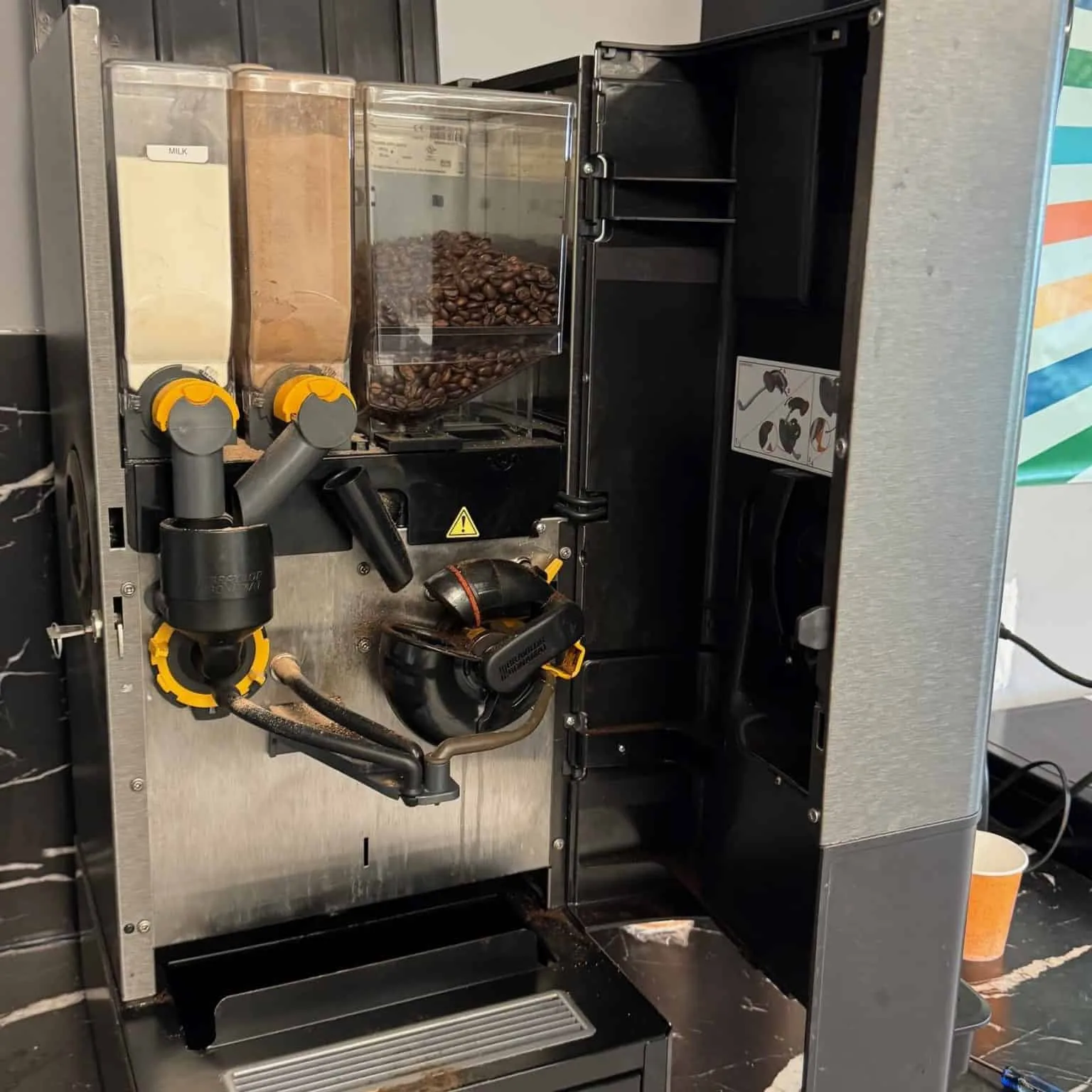
- Bean hopper Grinder & dosing
- The container that holds whole beans above the grinder. On commercial super-automatics it feeds an integrated grinder; on traditional setups it sits on a standalone grinder. Bridging (beans clumping above the grinder throat) and humidity exposure are the main hopper-related faults we see. We carry replacement hopper gates, augers, and seals for Schaerer, Franke, WMF, and VKI super-automatic platforms.
- Bean-to-cup Machine category
- The everyday name for a machine that grinds whole beans and brews per cup on demand; in commercial contexts it's effectively a synonym for super-automatic. The label spans everything from compact office units by Bellucci, Carimali, HLF, and Rex-Royal up to high-volume hospitality platforms. Whatever the badge, the service profile is the same trio: brew unit, grinder, milk path, covered across our coffee machine repair work.
- BestFoam Schaerer Brand-signature tech
- Schaerer's signature milk foaming technology, used across the Coffee Soul and Coffee Skye platforms. It produces dense microfoam suitable for latte art on a super-automatic, with foam density tuneable per drink profile. Foam quality issues on Schaerer machines almost always trace to milk-line buildup or a worn foam attachment rather than the BestFoam architecture itself. We handle BestFoam service across the GTA as part of our repair and service work.
- Black&White4 Thermoplan Brand-signature tech
- Thermoplan's modular Swiss-built super-automatic platform, configured per site as coffee-only, fresh-milk, or full milk-foam variants (the CTS and CTM designations). Thermoplan also builds the machines behind some of the world's largest café chains, so the platform's parts ecosystem and reliability record are strong. Brew unit seals, grinder calibration, and milk system sanitation are the main service items on the Black&White4 and the newer B&W4 Neo, and we handle them as part of our Thermoplan repair work.
- Blind basket (backflush disc) Cleaning & maintenance
- A solid, holeless filter basket that seals the portafilter for backflushing: with nowhere to go, water and detergent get forced backwards through the group head and out the three-way valve. Only machines with a three-way valve can be backflushed, which is why blind baskets are standard kit on commercial machines and absent from many entry-level home units. Daily water backflushes and weekly detergent backflushes with a blind basket are the baseline for any group doing volume, and we verify the routine on every maintenance visit.
- Boiler Core hardware
- The pressure vessel that heats water for brewing or steam. Commercial machines run boilers at temperatures and pressures that demand periodic service: descaling, pressurestat or PID calibration, and inspection of the heating element and safety valves. Boiler architecture (single, dual, multi, or heat-exchanger) defines what the machine can do simultaneously. Boiler commissioning is part of our installation services.
- Boiler drain valve Core hardware
- The fitting at the low point of the boiler that lets a technician empty it for descaling, element work, or transport. Seized drain valves are common on machines that have never been properly serviced, and forcing one is how boilers get damaged. If a machine is being moved or stored anywhere near freezing, draining the boilers first is not optional; see our note on machine installs and relocations.
- Boiler flush Cleaning & maintenance
- Draining and refilling the steam boiler to dump the concentrated mineral water inside. Steam boilers only ever lose pure steam, so the minerals stay behind and the remaining water gets saltier and scummier over months, eventually spitting white flecks through the steam wand. A periodic flush resets the concentration and is a routine part of our preventive maintenance on steam-heavy machines.
- Bottomless (naked) portafilter Traditional espresso
- A portafilter with the bottom and spouts machined away so the basket's underside is fully visible during extraction. It's a diagnostic instrument: channeling, uneven distribution, and basket problems show up instantly as spritzes and dead spots in the flow. We pull shots on a bottomless portafilter when diagnosing extraction complaints on espresso machine repair visits because it shows in ten seconds what gauges can't.
- Brew bypass (batch brewing) Batch & filter brewing
- A valve in a batch brewer that routes a set percentage of the water around the coffee bed and straight into the dispenser. Big batches need it: pushing every litre through the grounds would over-extract the coffee, so the bypass dilutes to target strength instead. A miscalibrated bypass makes coffee watery or harsh in ways no bean change fixes, and setting it correctly is part of brew calibration on the batch systems we service under coffee machine repair.
- Brew chamber Core hardware
- The sealed cavity inside a super-automatic brew unit where ground coffee is compressed and extracted. On most platforms it's a removable assembly that includes the piston, screens, and seals. Brew chamber seal replacement is a high-frequency service item, especially on Schaerer, Franke, Jura, and VKI super-automatics, and a leaking chamber is the most common cause of grounds-in-the-cup complaints. Routine preventive maintenance catches chamber wear before it becomes a service call.
- Brew group Core hardware
- The combined assembly that delivers hot water to ground coffee on a traditional espresso machine. It includes the group head, dispersion screen, gasket, and the supporting boiler or saturated chamber. A saturated brew group is built directly into the boiler for maximum thermal stability and is standard on La Marzocco, Synesso, and Kees van der Westen machines.
- Brew ratio Coffee chemistry
- The ratio of dry coffee dose to liquid espresso in the cup, written like 1:2 (18 grams in, 36 grams out). Ratio, time, and grind are the three numbers that define a shot recipe, and ratio is the one that sets drink strength. Standard espresso runs near 1:2, ristretto closer to 1:1.5, lungo at 1:3 or longer. Brew ratio comes up in every taste-related diagnosis we run during espresso machine repair because it separates recipe problems from machine problems.
- Brew unit Core hardware
- The mechanical assembly inside a super-automatic that grinds, doses, compresses, brews, and ejects each shot. It's typically a removable cartridge with a piston, drive gears, screens, and seals. The brew unit is the single most service-intensive component on any super-automatic, and worn seals or stripped drive gears are the most common cause of brew faults and error codes. We work on every brew unit architecture across the GTA, including Schaerer, Franke, Jura, WMF, Eversys, and Thermoplan. Scheduled preventive maintenance extends brew unit life significantly.
- BrewWISE Bunn Brand-signature tech
- Bunn's digital brewer control system on its DBC brewer lines: programmable recipes by volume and strength, digital temperature control, and smart funnels that tell compatible grinders and brewers which coffee is loaded. For multi-site operators it standardizes brew quality across locations without relying on staff memory. Recipe verification after any repair is part of servicing BrewWISE-equipped fleets.
- Burrs (flat and conical) Grinder & dosing
- The cutting surfaces inside a grinder that break beans down to espresso fineness. Flat burrs sit parallel and produce a uniform particle size, suited to specialty espresso. Conical burrs nest one inside the other and run cooler, suited to higher-volume commercial use. Burrs wear out: replacement intervals depend on volume, but most commercial setups need new burrs every 500 to 1,500 kg of coffee. Scheduled burr replacement on the integrated grinders inside super-automatics is part of our maintenance services.
- Bypass doser (powder chute) Grinder & dosing
- The slot on a super-automatic that accepts pre-ground coffee, usually for decaf, so the machine can brew it without running the main grinder. Jams here are common and almost always operator-side: clumpy pre-ground, overfilling, or products that were never meant for the chute. Chocolate and vending powders belong in a dedicated powder system, never the bypass doser. Clearing and recalibrating the chute is a quick fix during coffee machine repair on Schaerer, Franke, and Jura platforms.
- Bypass setting (filter blend) Cleaning & maintenance
- The adjustable dial on many commercial filter heads that lets a percentage of water skip the softening stage. Coffee wants some mineral content for extraction, so the bypass blends treated and untreated water to hit a target hardness rather than stripping everything. A bypass set wrong at install either wastes cartridge capacity or under-protects the boiler; we set and record it at every installation as part of the water spec.
C
- Cafina XT series Melitta Professional Brand-signature tech
- Melitta Professional's Swiss-built commercial super-automatic line, running from the compact XT4 up to the high-volume XT8. The platform is known for its stainless brew unit, unusual among super-automatics where plastic brew units dominate, which changes the wear profile: fewer brew unit replacements, with seals and gaskets as the recurring items. Grinder calibration and milk system sanitation round out the service picture, all part of our Melitta Professional repair work.
- Capacity rating (cups per day) Machine category
- The manufacturer's guideline for how many drinks per day a machine is built to sustain. Running a 100-cup office machine at 300 cups doesn't fail immediately; it fails in six months, through grinder burnout, brew unit wear, and boilers that never rest. Matching machine capacity to real traffic is the single best predictor of service costs, and it's the first question we ask in any installation consult.
- Cappuccino Drinks & recipes
- Espresso with steamed milk and a deep cap of foam, classically in even thirds. It's the drink that stresses a milk system hardest: the foam volume demanded is where worn frother parts, milk-line buildup, and bad milk temperature show first. When a super-automatic's cappuccino goes flat while its latte stays fine, that's a foam-path fault, a distinction that speeds up milk system diagnosis.
- Capsule and pod machines Machine category
- Machines that brew from sealed single-serve packs instead of fresh-ground beans. In offices the dominant example is Flavia, whose Creation series brews each drink through a sealed packet that keeps the machine's water path and the coffee from ever touching, so there's no grinder and minimal daily cleaning. The tradeoff is per-cup cost and drink quality versus bean-to-cup. Service work centres on the brew mechanism, pumps, and heaters, all part of our coffee machine repair coverage.
- Carbon filtration Cleaning & maintenance
- Activated carbon stages remove chlorine, chloramine, and taste and odour compounds from municipal water before it reaches the machine. Carbon protects flavour and rubber seals but does nothing about hardness, which is why commercial coffee filtration pairs carbon with softening in one cartridge. Toronto's municipal water is chlorinated, so carbon is effectively mandatory on any machine that wants the coffee to taste like coffee. Carbon capacity exhausts silently, another reason cartridge change intervals from our filter guides matter.
- CBS Extractor series Fetco Brand-signature tech
- Fetco's Coffee Brewing System line, the batch brewers found behind a huge share of specialty and chain coffee programs. The platform's cascading sprayhead and programmable pulse-brew profiles are why a well-set Fetco can hold its own against far fussier brew methods at volume. Sprayhead cleaning, brew-volume calibration, and tank descaling are the recurring service items on the CBS series.
- Channeling Extraction control
- When water tears a low-resistance path through part of the coffee puck instead of flowing evenly through all of it. The result is coffee that's simultaneously sour, from the under-extracted zones, and bitter, from the over-extracted channels. Causes stack from grind and distribution technique up to a blocked shower screen or worn group gasket, which is why persistent channeling on a commercial machine deserves a mechanical check during espresso machine repair, not just barista blame.
- Check valve Core hardware
- A one-way valve that lets water flow toward the boiler but never back toward the supply. A weak check valve lets boiler pressure push hot water backwards into the fill circuit, which shows up as odd pressure readings, slow fills, or a machine that loses prime overnight. Small part, quick swap, common find on espresso machine repair calls.
- CLARIS filter Jura Brand-signature tech
- Jura's proprietary in-tank water filter cartridge line (Blue, Smart, and Smart+ generations, with the professional sizes used across the GIGA and X series). The Smart generations carry an RFID-style tag so the machine detects the cartridge and tracks its capacity automatically, and with an active CLARIS fitted Jura machines suppress their descale cycles because the filter is doing that job. Running expired cartridges quietly re-exposes the thermoblock to scale, so we verify filter status on every Jura service call. See our Jura filter guide for cartridge matching.
- Classe series Rancilio Brand-signature tech
- Rancilio's commercial espresso line, the Classe 5 through Classe 20, built around straightforward serviceability: conventional layouts, accessible components, and parts that stay available for years. It's the machine equivalent of a reliable fleet vehicle, which is why so many multi-site operators standardize on them. Routine group rebuilds and volumetric calibration keep a Classe honest for a decade or more of service.
- Cleaning lockout Controls & electronics
- The enforced stop on modern super-automatics that refuses to brew (especially milk drinks) until an overdue cleaning cycle runs. It exists because skipped milk cleans are a food-safety issue, not a suggestion. A machine 'down' with a cleaning demand on screen isn't broken; run the cycle with the right products and it releases. If lockouts recur unusually often, a sensor or dosing fault may be triggering them early, which is worth a service look.
- Cleaning tablets and detergents Cleaning & maintenance
- The detergent products a machine's cleaning routine depends on: tablets for brew unit and group cleaning cycles, liquid cleaner for milk systems, and powder for backflushing traditional groups. Skipped or wrong-product cleaning is the single most common root cause behind milk faults and bitter coffee on super-automatics. Run the products and schedule the machine's manual specifies; the rinse cycle alone can't clean what it's never given. Where daily cleaning has lapsed, a deep clean during scheduled maintenance resets the machine, and our maintenance cost guide covers what that service runs.
- CleanMaster Franke Brand-signature tech
- Franke's integrated automated cleaning system: machines with the CM designation carry an onboard cleaning cartridge and run their milk-system clean at the push of a button, no manual mixing. It removes the human failure point from daily milk hygiene, which is exactly where most milk faults start. The cartridge still has to be present and in date, the first thing we check on a Franke milk complaint.
- Clumping and static Grinder & dosing
- Ground espresso's tendency to form dense clumps and cling with static charge, worse with fine grinds, fresh beans, and dry winter air. Clumps brew as channels unless broken up, which is the entire reason WDT tools exist. Persistent clumping from a commercial grinder can also flag dull burrs crushing instead of cutting, worth checking during grinder maintenance before blaming the weather.
- Coffee Link Schaerer Brand-signature tech
- Schaerer's cloud telemetry platform. Connected machines report drink counts, cleaning compliance, and fault codes to a central dashboard, so an operator can see a machine skipping its milk cleans before the foam complaints start. Like most telemetry systems, connectivity problems usually trace to the site's network rather than the machine. Comparable platforms include de Jong Duke ConnectMe and WMF CoffeeConnect, and on coffee machine repair calls the event log genuinely shortens diagnosis.
- Coffee urn Batch & filter brewing
- The high-capacity brewer-and-holding vessel combination built for banquets, churches, and institutions, from classic percolator-style urns to modern brew-and-hold systems from Grindmaster, Bloomfield, and Newco. Holding temperature and honest cleaning are the whole game: coffee held too hot too long goes bitter no matter how well it brewed. Descaling and thermostat checks keep urns serviceable for decades.
- Coffee vending machine Machine category
- Floor-standing or countertop machines built for unattended self-serve: cup dispensing, payment systems, and high-capacity ingredient canisters on top of a bean-to-cup or instant brewing engine. Necta's Krea and Kalea lines and de Jong Duke's machines are the platforms we meet most across GTA offices and institutions. Vending adds its own service layer beyond the brewer: mixer bowls, powder systems, cup mechanisms, and payment hardware, all covered in our coffee machine repair work.
- CoffeeConnect WMF Brand-signature tech
- WMF's telemetry and fleet-management platform for its commercial machines. It reports consumption, cleaning status, and fault codes to a central dashboard and can push recipe and configuration updates to machines remotely. For operators running WMF fleets across multiple sites, from the 1500 S+ up to the 9000 S+, it turns service dispatch from reactive to scheduled. We work alongside CoffeeConnect data on WMF service calls; the fault history is often the fastest route to the failed part.
- Cold brew Drinks & recipes
- Coffee steeped in cold water for 12 to 24 hours instead of brewed hot, yielding a low-acid concentrate served over ice or on nitro taps. Commercial cold brew brings its own equipment: steeping vessels, filtration, kegs, and dispense taps, with sanitation as the main service concern since nothing in the path runs hot. We service cold-side dispense equipment alongside the hot machines in our coffee machine repair work.
- Cold foam Milk system
- Milk foamed cold rather than steamed, the texture behind iced lattes and cold cappuccinos. Newer super-automatic milk systems produce it on demand: Franke's SB1200 FoamMaster and Eversys platforms both run programmable cold foam alongside hot. Cold milk paths raise the hygiene stakes, since nothing in the path is ever heat-sanitized by use, so daily cleaning discipline and on-schedule milk system service matter even more than on hot-only machines. Cold foam faults are part of our regular milk system repair work.
- Commissioning Service category
- The first proper startup of a machine on site: water spec verified and filtration fitted, line pressure regulated, boiler temperatures and pressures calibrated, recipes programmed, and staff walked through daily care. A machine that skips commissioning usually announces it within months, through scale, drifted recipes, or cleaning routines nobody was shown. Commissioning closes every installation we do, on everything from single-group espresso machines to multi-machine office fleets; the installation cost guide shows what's included.
- ConnectMe de Jong Duke Brand-signature tech
- de Jong Duke's cloud telemetry platform for office coffee fleets. It reports drink counts, machine health, and fault codes back to a central dashboard so operators can schedule service before failures. Connectivity issues on ConnectMe usually trace to local Wi-Fi or firewall configuration, not the machine itself, and we coordinate with the customer's IT contact where the network is the root cause. Telemetry-enabled OCS fleets are a core part of our service and repair work across the GTA.
- Controller board Controls & electronics
- The main circuit board that runs everything: temperature control, dosing, motor drives, cleaning cycles, and the fault messages on the display. Boards get blamed far more often than they fail. Most suspected board faults trace back to a sensor, a wiring connector, or a scaled probe feeding the board bad data, so we diagnose the input side first. A controller board is one of the most expensive parts in the machine and usually the last thing actually wrong; our repair cost guide shows where board replacement sits against typical fixes.
- Cool-touch steam wand Milk system
- A double-walled steam wand that stays touchable in use and sheds milk instead of baking it on. The design protects baristas from burns and cuts wand-cleaning time, which is why it's now standard on machines from Nuova Simonelli, Victoria Arduino, and others. The inner wand still needs the same purge-and-wipe discipline; cool-touch buys forgiveness, not immunity.
- Cooling flush Group head architecture
- The short water flush a barista runs on a heat-exchanger machine to purge overheated water from the group before pulling a shot. HX machines idle with brew water above target temperature, and the flush length sets the actual brew temperature, which makes it a skill and a variable. Saturated and PID-controlled machines eliminated the ritual, but on the Faema, Rocket, and other E61-style machines we service it's still part of correct operation.
- Cortado Drinks & recipes
- Equal parts espresso and lightly steamed milk, around 4 ounces, with barely any foam. The cortado's near-flat milk exposes steam temperature control: overheated milk has nowhere to hide in a drink this small. On programmable machines it's a low-volume, low-foam milk recipe, and a good test drink when we calibrate milk systems.
- Crema Coffee chemistry
- The reddish-brown foam layer on top of a properly pulled espresso shot. It forms when CO2 dissolved in the bean is released under pressure during extraction and emulsifies with oils. Poor crema points to stale beans, grind too coarse, pressure too low, or a temperature stability problem in the group head. We diagnose crema issues regularly on Faema, La Marzocco, Nuova Simonelli, and Rancilio service calls.
- Cup warmer Core hardware
- The heated or passively warmed top surface of an espresso machine where cups preheat. A cold cup can pull several degrees out of a shot, which matters for a drink served at 4 ounces. Passive warmers just borrow boiler heat; active ones add an element with its own switch and occasional failures. If drinks suddenly run cool with the machine otherwise healthy, cup temperature is worth ruling out before deeper diagnostics.
D
- Degassing Coffee chemistry
- The CO2 release from coffee beans in the days after roasting, which is why coffee bags carry one-way valves. Very fresh beans gush gas during extraction, producing wild crema and fast, uneven shots; beans past their window produce thin crema and flat taste. When shot behaviour changes with nothing mechanical touched, bean age is a prime suspect, and it's one of the first questions we ask on a taste complaint before booking an espresso machine repair visit.
- Descale solution Cleaning & maintenance
- The acid product that dissolves mineral scale during descaling, typically based on citric, lactic, or sulfamic acid. The acid matters: manufacturer-specified products at the right concentration clean without attacking boiler metals and seals, while vinegar and improvised descalers damage seals and leave taste behind. Using the right chemistry is part of why a professional descale outlives a DIY one.
- Descaling Cleaning & maintenance
- The process of dissolving mineral scale (limescale) from the inside of boilers, heating elements, and water pathways. Hard water in much of the GTA accelerates scale buildup, which insulates the heating element, restricts flow, and triggers temperature faults. Schedule depends on water hardness and volume: every 3 to 6 months for unfiltered machines, less often when proper water filtration is installed. Descaling is part of every preventive maintenance visit we run, and a standalone service we offer for machines past their schedule.
- Dialing in Extraction control
- The process of adjusting grind size, dose, and shot time until espresso hits its target brew ratio and tastes right. Cafés dial in every morning and after every new coffee; technicians dial in after any work that touches the grinder or brew path, because a machine can be mechanically perfect and still taste wrong on yesterday's settings. Expect a dial-in as the closing step of any grinder or group service we do during maintenance on La Marzocco, Sanremo, Victoria Arduino, and similar specialty platforms.
- Distribution tool (leveler) Traditional espresso
- The spinning wedge-based tool that levels the top of the coffee bed after dosing and before tamping. It complements needle-style WDT rather than replacing it: needles fix clumps through the whole bed, a leveler squares the surface. Consistent distribution is the cheapest extraction upgrade a busy bar can make, and it takes technique variation between baristas out of the picture. We check distribution habits alongside the machine itself on extraction-related service calls.
- Doppio Drinks & recipes
- A double espresso: two spouts' worth from one double basket, roughly 36 to 40 grams of liquid from 18 to 20 grams of coffee. The doppio is the default 'single drink' in most commercial settings; true single baskets brew differently enough that many bars skip them entirely. On super-automatics, note whether a double is one large extraction or two cycles back to back; the taste and the wear profile differ.
- Dose and dose drift Grinder & dosing
- The mass of ground coffee delivered per shot. Commercial machines target a dose tolerance of about plus or minus 0.3 grams. Dose drift is when that target moves over time, usually from burr wear, hopper humidity, or a worn timer-based grinder that's no longer matching gravimetric output. We measure dose by weight on every service call where the operator reports inconsistent shots. Dose calibration is part of every scheduled maintenance visit, and we work on integrated dosing systems across Schaerer, Franke, Jura, and Eversys super-automatics.
- Doser (grinder) Grinder & dosing
- The chambered dispenser on older-style grinders that collects ground coffee and portions it into the portafilter one lever-pull at a time. Dosers made sense for nonstop volume; for anything less they leave grounds sitting stale between orders, which is why grind-on-demand replaced them across most installs. Sweeper vanes and the doser spring are the wear items when we service the survivors on older espresso setups.
- Drink counters Controls & electronics
- The internal tallies a machine keeps of every drink, cleaning cycle, and litre of water it has processed. Counters are the machine's odometer: they schedule maintenance honestly (brew unit seals at N cycles, burrs at N kilograms) and settle arguments about how hard a machine has actually been run. Reading the counters is the first thing we do on any maintenance assessment of an unfamiliar machine.
- Drip tray and drain line Core hardware
- The tray under the group heads that catches rinse water, drips, and the three-way valve's post-shot discharge, plus the drain hose that carries it to the building drain. Unglamorous, but a clogged drain line is one of the most common causes of water on the counter, and coffee sludge blocks drain hoses surprisingly fast. On super-automatics the tray also holds level sensors that stop the machine when full. Drain flushing is a standard step on our maintenance visits and coffee machine repair calls.
- Dual-boiler architecture Boiler architecture
- A machine design with two independent boilers, one for brewing and one for steam. Brew temperature is held by a PID controller on the smaller boiler, while the steam boiler runs hotter for milk work. Dual-boiler machines deliver the most thermally stable shots in commercial use and are standard on La Marzocco, Synesso, Slayer, and most premium specialty platforms. Our installation services include dual-boiler commissioning and per-boiler temperature calibration.
- Dynamic Coffee Assist WMF Brand-signature tech
- WMF's self-adjusting extraction system on the 5000 S+ and 9000 S+. It monitors each espresso's extraction time and automatically corrects grind fineness and dose to keep shots in spec, compensating for bean age, humidity, and burr wear without anyone touching a setting. It's the super-automatic answer to daily manual dialing in. When Dynamic Coffee Assist can no longer hold the target, that's usually the grinder telling you its burrs are due, a check we run during WMF maintenance.
- Dynamic Milk WMF Brand-signature tech
- WMF's milk system that adjusts foam density per drink profile through controlled air injection and milk-flow timing. It's used on the WMF 1500S+ and 5000S+ platforms across hospitality and OCS. Most Dynamic Milk faults are milk-line buildup from skipped daily cleans, not hardware failure, and the same applies across Franke FoamMaster and Schaerer BestFoam equivalents. Dynamic Milk service is part of our regular repair work.
E
- e'Connect Eversys Brand-signature tech
- Eversys's telemetry platform, streaming drink counts, machine health, and cleaning compliance from Cameo and Enigma fleets to a live dashboard. It completes the telemetry picture alongside Schaerer Coffee Link, WMF CoffeeConnect, and de Jong Duke ConnectMe: whichever badge is on the machine, remote fault history now shortens most service calls.
- e'Foam Eversys Brand-signature tech
- Eversys's milk foaming system, used across the Cameo and Enigma platforms. It produces foam densities comparable to a manually steamed barista pour, and the foam target is settable per drink profile. e'Foam service work centres on milk-line sanitation and the periodic replacement of the foam-mix nozzle and O-rings. We handle e'Foam service as part of our repair work across the GTA.
- E61 group head Group head architecture
- A thermosyphon-circulated group head introduced by Faema in 1961, still in use across Faema, Bezzera, ECM, Rocket, and other heat-exchanger machines. It maintains brew temperature by circulating water from the boiler through the group, with a built-in pre-infusion via the saturated chamber. The E61 is one of the most copied and serviced group designs in commercial espresso.
- Eagle One and the NEO engine Victoria Arduino Brand-signature tech
- Victoria Arduino's sustainability-focused espresso platform. The Eagle One uses a compact low-mass brew system that heats quickly instead of keeping a large boiler hot all day, and the E1 Prima brings the same NEO engine approach to a one-group format. The design cuts idle energy use dramatically, which is a real operating-cost difference for a café running the machine 14 hours a day. We service the Eagle One family as part of our Victoria Arduino repair work.
- Eccellenza platform VKI Brand-signature tech
- VKI's current commercial super-automatic line, including the Eccellenza Touch, Eccellenza Momentum, and Eccellenza Café. It pairs the Reverse French Press brewing chamber with a touchscreen interface, integrated bean grinder, and OCS telemetry. The Eccellenza brew chamber is unique to VKI and requires the manufacturer-spec procedure during seal replacement to avoid grounds leakage, which is the most common service item on the platform. Eccellenza fleets are widely deployed across Canadian OCS routes, and we service them across the GTA as part of our repair and service work.
- Eco mode and standby Controls & electronics
- Programmed energy-saving states that drop boiler temperatures or power down heating during quiet hours and overnight. On a machine that idles 12 hours a day the savings are real, and scheduled wake-ups mean the machine is hot before the first order anyway. The tradeoff to know about: aggressive eco settings on some platforms confuse staff into thinking the machine is broken when it's asleep. We set sensible schedules as part of commissioning.
- Electrical requirements Service category
- What a machine needs from the wall, and the most common installation surprise. Small machines run on a standard 15 amp circuit; serious espresso machines and super-automatics commonly want dedicated 20 amp or 208-240V circuits, and multi-group machines more still. Sharing a circuit with other kitchen equipment causes nuisance breaker trips that masquerade as machine faults. Confirming supply against the spec sheet is part of every site survey we run.
- Error codes Controls & electronics
- Numbered fault messages the controller puts on the display when a sensor reading goes out of range: fill timeouts, temperature faults, brew unit jams, milk system errors. The code tells you the subsystem; it rarely tells you the part. We publish plain-English error code guides for every brand we service, including Schaerer error codes, Franke error codes, and Jura error codes, covering what each code means and what's safe to try before you call.
- Esprecious Bravilor Bonamat Brand-signature tech
- Bravilor Bonamat's Esprecious line brings true bean-to-cup espresso to a brand better known for fresh-brew and filter equipment, aimed squarely at offices and self-service. Dutch-built, compact, and designed for unattended reliability, it shares the standard super-automatic service profile: brew unit seals, grinder calibration, and milk path sanitation on the milk-equipped variants.
- Espresso Coffee chemistry
- A concentrated coffee preparation made by forcing hot water through finely-ground coffee at roughly 9 bar of pressure. A standard double shot uses 18 to 20 grams of coffee, pulls 36 to 40 grams of liquid out, and takes 25 to 32 seconds. Any deviation from these targets is what we look at first on a 'shots taste off' service call, alongside extraction yield and TDS. Commercial espresso platforms we service include La Marzocco, Synesso, Slayer, Faema, Nuova Simonelli, and Rancilio.
- Expansion valve (OPV) Core hardware
- A spring-loaded relief valve that bleeds off excess pressure in the brew circuit, typically set around 11 to 12 bar. It protects the pump and plumbing from pressure spikes and, on many machines, effectively defines maximum brew pressure. A drifted or scaled expansion valve shows up as brew pressure creeping away from the 9 bar target on the front gauge. Adjustment and replacement are routine jobs we handle from truck stock during espresso machine repair visits.
- Extraction yield Coffee chemistry
- The percentage of soluble material extracted from ground coffee during brewing. Target range for espresso is roughly 18% to 22%. Under-extraction tastes sour, over-extraction tastes bitter. Extraction yield is what shifts when grind, dose, temperature, or pressure drift out of spec, and it's the diagnostic measure we use on every taste-related service call.
F
- Filter cartridge Cleaning & maintenance
- The replaceable in-line unit that treats water before it reaches the machine, typically combining softening resin, activated carbon, and particle filtration. Cartridges are rated in litres of capacity at a given water hardness, so the right change interval depends on both your water and your volume; an exhausted cartridge protects nothing. Brita, BWT, Everpure, and 3M systems dominate commercial installs. We publish machine-specific filter recommendations for every brand we service and size cartridges as part of every installation.
- filterfresh de Jong Duke Brand-signature tech
- de Jong Duke's signature fresh-brew filter coffee process for single-cup machines. It brews ground coffee fresh per cup through a paper-filter cartridge, closer to a pourover profile than to espresso or pod-based machines. filterfresh service work focuses on the brew chamber, the filter advance mechanism, and the grinder feeding it. We service filterfresh-equipped de Jong Duke machines across Toronto and the GTA as part of our repair and service work.
- Firmware updates Controls & electronics
- The machine's operating software, updated by USB stick or over the network on connected machines. Manufacturers ship fixes for real faults this way: cleaning cycle bugs, milk temperature drift, false error triggers. A machine several firmware versions behind can exhibit 'faults' that no part replacement will ever fix, so checking the version is an early step in our repair workflow on late-model equipment.
- Flat white Drinks & recipes
- A smaller, stronger milk drink: espresso (often a double ristretto) under velvety microfoam with minimal froth depth, served around 5 to 6 ounces. The flat white is unforgiving of coarse foam, which makes it the drink baristas use to judge a milk system honestly. Super-automatics reproduce it with a low-foam, high-density milk profile where the platform supports one.
- Flow meter Core hardware
- The small turbine sensor that counts water volume on its way to the group head, feeding a pulse count back to the controller for volumetric dosing. When programmed shot volumes drift, a dirty flow meter is the usual suspect: scale and debris slow the turbine, so the machine believes less water has passed than actually has. Cleaning is routine and replacement is rare. Flow meter service applies across every volumetric machine in our espresso machine repair work, and drift checks are part of scheduled maintenance.
- Flow profiling Extraction control
- Modulating water flow rate through the puck during a shot, typically to start slow, ramp up at peak extraction, and taper off at the end. It gives a barista control over extraction yield and mouthfeel beyond what fixed-pressure pumps allow. Slayer and Synesso machines build this in mechanically; modern La Marzocco platforms (KB90, GB5 Steel) do it electronically.
- Flow rate (debit) Extraction control
- How fast water passes through the group with no coffee in the way, measured in millilitres per second. Technicians check debit because it isolates the machine from the coffee: a slow debit means a clogged gicleur, scaled valve, or failing pump no matter what the barista changes. Debit checks bracket every water-path repair we do, before and after the fix.
- FoamMaster Franke Brand-signature tech
- Franke's milk system across the A800, A1000, and SB1200 platforms. It delivers cold and hot milk foam with per-drink density profiles, plus an automatic cleaning cycle that runs on a schedule. FoamMaster service centres on the milk pathway: the foam chamber, O-rings, and milk-line sanitation. We carry FoamMaster service parts on the truck for first-visit resolution across our repair work.
- Fresh brew Batch & filter brewing
- A brewing method that drips hot water through a fresh paper or fine-mesh filter of ground coffee for each cup, sitting between espresso and batch drip in character. It's the backbone of office coffee across much of Europe and Canada: de Jong Duke's filterfresh, Bravilor Bonamat, and Animo machines all use it on Canadian OCS routes, and Franke's Fresh Brew variants bring it to the A-line. Brew chamber seals, filter transport, and grinder wear are the main service items in our coffee machine repair work.
- Frother Milk system
- Any mechanism that aerates and heats milk to produce foam. On super-automatics it's an integrated automatic system; on traditional machines it's the steam wand operated by the barista. Frother service problems are almost always milk-protein buildup from skipped daily cleans, not hardware failure, and the fix is daily protocol enforcement plus periodic O-ring and line replacement. We service every major automatic frother architecture, including Schaerer BestFoam, Franke FoamMaster, WMF Dynamic Milk, and Eversys e'Foam.
G
- G4 platform Wilbur Curtis Brand-signature tech
- Wilbur Curtis's touchscreen brewer control platform, running its batch coffee and tea equipment with programmable recipes, pulse brewing, and on-screen diagnostics. The interface surfaces service data (temperatures, error history, cycle counts) that older analog brewers made technicians infer, which shortens diagnosis. Beyond the screen it's proven Curtis hardware: tanks, valves, and sprayheads with the usual descale-and-calibrate service rhythm.
- Gicleur Core hardware
- A small brass jet with a precisely drilled hole, typically 0.5 to 1.2mm, that restricts water flow between the pump and the group head. The gicleur sets how fast a shot builds pressure, and a partially blocked one is a classic cause of slow shots that no grind adjustment fixes. Scale and coffee fines both clog gicleurs, so checking and clearing them is part of a proper group service. We inspect gicleurs during scheduled maintenance on La Marzocco, Faema, Nuova Simonelli, and similar platforms.
- GIGA platform Jura Brand-signature tech
- Jura's flagship professional line, with dual grinders and dual thermoblocks so the machine can run two products (or grind two blends) in parallel. The GIGA X8 adds a speed function that blends a hot-water bypass into long drinks to cut queue times. Dual everything also means dual wear points, so grinder and brew unit counters get watched on both sides during maintenance.
- Gravitech Victoria Arduino Brand-signature tech
- Victoria Arduino's gravimetric dosing system on the Black Eagle Maverick: scales built into the drip tray weigh the espresso in the cup in real time and stop the shot at the programmed weight. That removes flow meter drift and volumetric guesswork from the recipe entirely, which is why gravimetric machines hold brew ratios so consistently across a shift. Scale calibration and cleanliness around the tray sensors are the service items to know about, and we handle them within our Victoria Arduino repair work.
- Grind retention Grinder & dosing
- The ground coffee that stays behind in the burr chamber and chute between shots. High retention means the first shot of the morning brews partly on yesterday's stale grounds, and it makes dose drift harder to chase because the grinder's output lags its setting. Retention climbs as coffee oils build up inside the chute, so periodic grinder teardown and cleaning is part of proper maintenance on both standalone grinders and the integrated grinders inside super-automatics we cover under coffee machine repair.
- Grind-on-demand (doserless) grinder Grinder & dosing
- A grinder that grinds directly into the portafilter per order instead of storing ground coffee in a dosing chamber. Fresher shots and less waste, at the cost of more duty cycles on the motor and burrs, which is why burr wear shows up faster on busy grind-on-demand setups. Every integrated grinder inside a super-automatic works this way by design. Grinder calibration and burr replacement are part of our scheduled maintenance across espresso machine installs.
- Grinder Grinder & dosing
- The machine or integrated module that grinds whole beans to the right particle size for brewing. Commercial grinders use flat or conical burrs and are sized by burr diameter (58mm, 64mm, 75mm, 84mm for traditional setups). Burr wear, dose drift, and grind-retention issues are common faults on the integrated grinders that ride inside every super-automatic we work on.
- Grounds drawer Core hardware
- The internal bin where a super-automatic ejects its spent coffee pucks. The machine counts ejections and locks brewing when it believes the drawer is full, so emptying it mid-count (without the machine noticing) or a faulty drawer sensor causes the classic 'empty grounds container' message on a visibly empty bin. Wet, smeary grounds in the drawer point at brew unit seal wear, a useful early warning we check during maintenance.
- Group gasket Traditional espresso
- The rubber ring seated in the group head that the portafilter compresses against to seal brewing pressure. Gaskets harden with heat cycles, and the telltale is water spraying or weeping around the portafilter rim mid-shot, or the handle swinging further past centre to lock. Replacement every 6 to 12 months is normal on a busy machine and is bundled into every scheduled maintenance visit alongside the shower screen. Our maintenance cost guide covers what a gasket-and-screen service typically runs.
- Group head Core hardware
- The portion of a traditional espresso machine where the portafilter locks in and water is dispensed onto the coffee puck. Most commercial machines have 1 to 4 group heads. Group-head temperature stability is the single biggest driver of shot consistency, which is why saturated and E61 groups exist. Group head rebuilds (gasket, screen, seal) are part of every scheduled maintenance visit on machines from La Marzocco, Synesso, Faema, Nuova Simonelli, and Rancilio.
- Groupe SEB WMF and Schaerer Brand-signature tech
- The French group (Tefal, Krups, and many others) that owns professional coffee's Swiss-German pair: WMF and Schaerer. The two develop side by side, and it shows in the family resemblance between their milk systems and their telemetry platforms, CoffeeConnect and Coffee Link. Cross-brand experience pays off directly here: time spent inside one brand's machines reads across to the other.
- Gruppo Cimbali La Cimbali, Faema, Slayer Brand-signature tech
- The Milanese group that owns La Cimbali, Faema, and Slayer, putting one parent behind machines that span classic Italian volume espresso to Seattle flow-profiling. Parent groups matter to service in practical ways: shared electronics, overlapping parts suppliers, and common service documentation across badges. Knowing who owns whom is often the shortcut to the right part.
H
- Heat exchanger (HX) Boiler architecture
- A boiler design with a single steam boiler and a brewing-water pipe (heat exchanger) running through it. Steam comes from the boiler, brewing water comes from the pipe that's heated by the boiler. HX machines deliver both brew and steam from one boiler at a fraction of the cost of a dual-boiler, with a slight tradeoff in brew-temperature stability. HX is the architecture behind most E61-equipped machines from Faema, Bezzera, Rocket, and La Cimbali.
- Heating element Core hardware
- The resistive element inside the boiler that actually heats the water. Scale is its enemy: a coated element runs hotter to deliver the same heat, recovers slower, and eventually burns out or trips the breaker. Long heat-up times and blown thermal fuses are the classic warning signs. Element replacement is routine, but without fixing the water the new element scales just as fast, which is why we pair it with a descale and a proper filter cartridge spec. Our repair cost guide covers where element work typically lands.
- Hot water boiler (counter-top) Batch & filter brewing
- The standalone counter-top water boiler that feeds tea service, pour-over bars, and instant products, from compact units to the multi-litre towers Marco and Animo are known for. One job, one enemy: scale, concentrated by all-day heating of hard water. Descaling intervals and a proper filter spec decide whether these run for years or fail annually.
- Hot water spout Core hardware
- The dedicated outlet that dispenses hot water for tea and americanos, fed from the steam boiler or a separate tank, often through a mixing valve. Scale builds here fast because the water sits hot and still between uses, and a spitting or dribbling spout is usually mineral buildup rather than a valve fault. We descale hot water circuits as part of scheduled maintenance on machines doing real tea volume.
I
- Iced tea and tea brewers Batch & filter brewing
- Dedicated machines from Fetco, Bunn, and Wilbur Curtis that brew tea hot and dispense it over ice into large dispensers. They share DNA with batch coffee brewers (sprayheads, tanks, volume calibration) plus one extra rule: tea equipment and dispensers need rigorous sanitation because sweet tea residue grows things coffee doesn't. Same service visit, same truck, part of our equipment repair coverage.
- Independent group boilers Dalla Corte Brand-signature tech
- Dalla Corte built its reputation on giving every group head its own dedicated boiler with independent temperature control, a design the brand pioneered commercially years before multi-boiler became a buzzword. Each group brews at its own setpoint, so one machine can run different coffees at different temperatures side by side. More boilers means more sensors and elements to service, but also no single point of thermal failure.
- iQFlow Franke Brand-signature tech
- Franke's brew-pressure profiling system on the A800 and SB1200. It modulates pump output during the shot to match a programmed pressure curve, similar to flow profiling on a traditional espresso machine. iQFlow recipe drift on a service call usually means the flow sensor or pressure transducer needs recalibration, which sits in the service menu. iQFlow service is part of our regular Franke repair work across the GTA.
- iSteam Egro Brand-signature tech
- Egro's automatic milk-steaming system across the One, Next, and Zero+ Pure platforms. It delivers programmed foam densities and temperatures per drink, with a self-cleaning cycle. iSteam service work focuses on milk-line sanitation, the steam injection valve, and the temperature sensor. Egro is part of the Rancilio Group / Ali Group family, and we service iSteam-equipped machines across our repair work.
K
- Knock box Traditional espresso
- The bin with a padded bar across the top that baristas knock spent pucks into between shots. Trivial hardware, but relevant to service: knocking the portafilter too hard against the bar bends spouts and warps baskets, and we see the results on 'no longer locks in cleanly' espresso machine repair calls. A firm tap, not a full swing, keeps the portafilter true.
L
- Latte Drinks & recipes
- Espresso under a large volume of steamed milk with a thin layer of foam, the volume seller in most cafés and offices. Because milk dominates the cup, latte complaints are usually milk complaints: temperature drift, thin texture, or off flavours from a milk path overdue for cleaning. On volume machines the latte recipe's milk dose is also the first thing to audit when an operator reports milk costs creeping.
- Leak detection Service category
- Water sensors placed under machines and in cabinets that shut the water feed or raise an alarm when they get wet. For plumbed machines above finished floors or in office towers, a failed fitting can run water all weekend, and the flood costs more than the machine. We recommend and fit leak protection as part of plumbed installations, especially anywhere the machine sits far from a drain.
- Level probe (autofill probe) Core hardware
- A conductive rod inside the boiler that senses water level and tells the controller when to top up. Scale coating the probe is the classic failure: the machine either overfills, pushing water out of the safety valve or steam wand, or refuses to fill and locks out on a fill timeout. Cleaning the probe and verifying the autofill circuit is a standard step in every boiler descale we run during maintenance, and proper water filtration keeps the probe clean between visits.
- Lever group Group head architecture
- A manually-operated espresso group where the barista uses a spring-loaded lever to compress the boiler water through the puck. It pre-dates electric pumps and is still made by Elektra, Bezzera, and Victoria Arduino for specialty and showpiece installations. Lever machines have very few electronic parts and tend to last decades with seal and spring service.
- Limescale Cleaning & maintenance
- The white-grey mineral deposit (mostly calcium carbonate) that builds up inside boilers and water pathways from hard tap water. It insulates heating elements (longer recovery times, higher energy use), restricts flow (slower fills, lower brew pressure), and eventually triggers temperature faults. Proper water filtration plus scheduled descaling is the only effective control. Limescale management is part of every preventive maintenance plan we build.
- Linea La Marzocco Brand-signature tech
- The machine that became shorthand for specialty coffee: La Marzocco's workhorse line, from the original Linea Classic that powered the 90s café boom to today's Linea Classic S and Linea PB. Dual boilers, saturated groups, and a parts ecosystem so deep that decades-old Lineas remain fully serviceable, which is exactly how we keep them running in La Marzocco repair work.
- Long black Drinks & recipes
- The Australian and New Zealand cousin of the americano: hot water first, espresso poured on top, preserving the crema. Same machine mechanics, opposite build order. Cafés serving a long black program it as a two-stage recipe on super-automatics that support ordered dispense; on traditional machines it's barista technique.
M
- Macchiato Drinks & recipes
- Espresso 'marked' with a spoonful of milk foam, a few sips of drink built directly in the demitasse. The caffè macchiato is espresso-forward, so its quality tracks shot quality almost entirely; if macchiatos taste off, look at extraction, not the milk system. Not to be confused with the inverted latte macchiato, which is mostly milk and programs as a layered recipe on super-automatics.
- Machine transport and winterizing Service category
- Moving a commercial coffee machine safely means draining the boilers first; in a Canadian winter it's mandatory, because residual water freezes in transit and splits boilers, valves, and fittings. Machines also travel badly on their backs (oil and water migrate where they shouldn't). We drain, secure, and recommission machines for moves as part of our installation services, and recommissioning includes a leak check the machine won't pass by accident.
- Manual espresso machine Machine category
- A traditional commercial espresso machine where the barista handles grinding, dosing, tamping, and dispensing every shot. Includes lever and semi-automatic machines, but not super-automatics. Manual machines dominate specialty café service and require trained operators. Platforms we service include La Marzocco, Synesso, Slayer, Kees van der Westen, Faema, and La Cimbali.
- Mavam undercounter system Mavam Brand-signature tech
- Mavam builds espresso machines where the entire engine (boilers, pumps, electronics) lives in a module below the counter, with only low-profile groups and controls on the bar. Like the Modbar concept, it trades counter presence for cabinet access, so service planning starts with how the module slides out. Clean sightlines, same fundamentals: groups, boilers, and water treatment sized to volume.
- Microfoam Milk system
- Milk steamed into a dense, glossy texture with bubbles too small to see, the standard for latte art and properly textured drinks. On a traditional machine it's a barista skill with the steam wand; super-automatics chase the same result mechanically with systems like Schaerer BestFoam, Franke FoamMaster, WMF Dynamic Milk, and Eversys e'Foam. When an automatic system stops producing microfoam, milk-line buildup or a worn foam component is almost always the cause.
- Microswitch Controls & electronics
- The miniature snap-action switches that tell the controller whether doors are closed, drawers are seated, and the brew unit is home. When a super-automatic insists a door is open or a grounds drawer is missing while both are plainly in place, a worn or crumb-jammed microswitch is the usual liar. They cost almost nothing and cause outsized downtime, which makes them a classic first check on coffee machine repair calls.
- Milk fridge module Milk system
- The refrigerated cabinet, side-mounted or under-counter, that holds the milk supply for a super-automatic. Food safety wants milk at or below 4°C, so the module's temperature sensor and door seals are genuine service items, and a warm fridge shows up first as off-tasting or poorly foaming milk. Milk lines from fridge to machine need daily cleaning cycles and periodic replacement. Fridge module faults ride along with milk system service on Schaerer, Franke, WMF, and Eversys installs.
- Milk pump Milk system
- The dedicated pump, usually peristaltic or gear-driven, that draws milk from the fridge module into the foaming system of a super-automatic. Worn pump tubing and milk-line buildup are the two most common causes of thin foam, inconsistent milk temperature, or sputtering, airy drinks. Milk pump service is routine across Schaerer, Franke, WMF, Eversys, and every milk-capable platform we work on.
- Milk temperature Milk system
- Steamed milk peaks in sweetness around 55 to 65°C; past 70°C the proteins scald and the drink tastes flat and eggy. Manual steaming is barista feel, but automatic systems rely on a temperature sensor in the milk path, and when that sensor drifts, every milk drink on the menu shifts together. Milk served suddenly cooler or hotter across all drinks is a sensor and calibration issue we correct during milk system service.
- Mixer bowl and whipper Core hardware
- The small chamber and high-speed whipper motor that turn instant powders into hot chocolate, vanilla drinks, and soup on vending machines and powder-equipped office machines. Crusted bowls, tired whipper motors, and worn shaft seals cause weak drinks, whining noises, and slow leaks, and skipped rinse cycles accelerate all three. Bowl teardown and seal replacement are routine on the Necta, de Jong Duke, and WMF powder systems we service.
- Mixing valve Core hardware
- The valve that blends boiler water with cold line water so the hot water tap dispenses at drinking temperature instead of steam-boiler temperature. When tea water suddenly comes out scalding or lukewarm, the mixing valve has usually drifted or scaled. Adjustment is part of hot-water calibration during maintenance.
- Mocha Drinks & recipes
- Espresso, chocolate, and steamed milk. In offices the chocolate usually comes from a powder dosing system rather than syrup, which ties mocha quality to powder freshness, mixer bowl cleanliness, and dosing calibration. Clumped powder and crusted mixer bowls are the usual suspects behind a bad mocha, all part of routine coffee machine service on powder-equipped platforms.
- Modbar La Marzocco Brand-signature tech
- The under-counter espresso system in the La Marzocco family: boilers and pumps live in modules below the bar, leaving only sleek taps on the counter. It transforms sightlines and workflow in high-design cafés, and it changes service logistics too, since work happens in the cabinet, not at the counter. We service the Modbar AV and Modbar EP as part of our La Marzocco work.
- Multi-group machines Machine category
- Espresso machines with two, three, or four group heads brewing in parallel, sized to peak queue rather than daily total. Each group is its own service point (gasket, screen, valve), and on non-saturated designs the outer groups can run cooler than the centre, which is why group-to-group consistency checks are part of maintenance on machines from Wega, Astoria, Crem, and every traditional builder.
- Mushroom (E61 group) Group head architecture
- The domed brass valve at the top of an E61 group head that water circulates around on its way to the puck. It sits at the hottest point of the thermosyphon loop, so it's where scale collects first, and a scaled mushroom causes temperature instability and flow problems on Faema, Rocket, Bezzera, ECM, and other E61 machines. Pulling and descaling the mushroom is a standard part of E61 group service during scheduled maintenance.
- Mytico Franke Brand-signature tech
- Franke's hybrid line that packages full super-automatic internals in traditional espresso-machine styling, with the Mytico Due and Mytico Vario aimed at front-of-house hospitality where the machine is part of the theatre. Under the bodywork the service profile is Franke super-automatic: brew unit seals, grinder calibration, and milk system care, shared with the A-line machines we already service. We handle Mytico machines as part of our regular Franke repair work.
N
- Needle-valve flow control Slayer Brand-signature tech
- Slayer's signature mechanism: a needle valve in each group's water path that the barista sets to shape flow mechanically, enabling the long, low-flow pre-brew the brand made famous. It's flow profiling without electronics, which makes it durable and rebuildable, and calibrating those needle valves is the heart of Slayer service. The company sits in the Gruppo Cimbali family alongside La Cimbali and Faema.
O
- O-rings and seals Core hardware
- The rubber and silicone rings that seal every joint in a coffee machine's water path: brew units, valves, wands, fittings, filter heads. Heat cycles harden them, coffee oils attack them, and a hardened O-ring is behind a huge share of drips, weeps, and pressure losses. Seal kits are standard consumables in preventive maintenance, replaced on schedule rather than after the leak.
- Office Coffee Service (OCS) Service category
- The distribution channel that places coffee machines in offices, maintains them, and supplies the beans, pods, and consumables. OCS operators run fleets of single-cup or super-automatic machines across corporate accounts, typically with telemetry feeding back to a central dispatch. Common OCS platforms in Canada include VKI Eccellenza, Cafection, de Jong Duke, and WMF. We service OCS-route equipment across the GTA as part of our repair and service work, alongside the operator's own technicians where needed.
- Oily beans Grinder & dosing
- Dark-roasted beans whose surface oils migrate out of the bean and onto everything they touch. Oils gum up hoppers, coat burrs, clog super-automatic brew units, and turn rancid in grinder chutes. Machines running dark, oily blends need noticeably shorter cleaning intervals, and a fleet's bean choice shows up directly in its maintenance costs. If a super-automatic jams repeatedly on the same blend, the beans are a suspect, not just the machine.
- Over-extraction and under-extraction Coffee chemistry
- The two directions espresso goes wrong. Under-extraction leaves flavour behind (sour, salty, thin); over-extraction takes too much (bitter, dry, hollow). The same shot can be both at once when water flows unevenly, which is why 'it tastes bad' needs the follow-up question: bad how? The answer points at grind, dose, temperature, or a mechanical fault, and it's how we triage taste complaints on service calls.
P
- P.E.P. (Pulse Extraction Process) Jura Brand-signature tech
- Jura's pulsed water-delivery technique that interrupts the brew flow several times during extraction to increase contact time on shorter shots. It targets espresso quality from a super-automatic on machines that can't run a full traditional-shot duration. P.E.P. faults on service calls trace to the brew unit drive or the controller, not the pulse logic itself.
- PID controller Extraction control
- A Proportional-Integral-Derivative controller that holds boiler or brew-water temperature to a precise setpoint, typically within plus or minus 0.5 degrees Celsius. PID replaces older pressurestat-based control and is standard on every modern specialty espresso machine. Recalibration after element or sensor replacement is part of standard service procedure across La Marzocco, Synesso, Slayer, and most modern Faema, Nuova Simonelli, and Rancilio machines.
- Plant-based milk in commercial machines Milk system
- Oat, soy, and almond milks foam differently from dairy: different proteins and fats mean different air uptake, and the barista editions exist specifically because standard versions foam poorly. In automatic milk systems, plant milks also leave different residues, so machines running them need the same daily cleaning discipline and sometimes shorter service intervals. Newer platforms from Eversys, Franke, and Schaerer support separate milk types with per-milk foam settings. We tune plant-milk foam quality as part of milk system service.
- Plumbed-in vs tank-fill Service category
- The two ways a machine gets water: a direct connection to the building's water line, with a shutoff, pressure regulator, and filter in the run, or a manually refilled internal tank. Plumbed-in is the default for any serious commercial volume because tanks run dry mid-rush and skip inline filtration. Many machines convert between the two with a kit. Line routing, regulator setting, and filter placement are core parts of our installation work, and the installation cost guide covers what a plumbed install involves.
- Point-of-use (POU) water systems Service category
- Water dispensers plumbed to the building supply with their own filtration, instead of swapping bottles. The same water-treatment logic that protects a coffee machine applies: cartridges sized to volume and hardness, changed on schedule, with sanitization at service. We supply and service POU coolers alongside coffee equipment as part of our water and filtration solutions, often sharing a filtration spec with the coffee machine beside them.
- Portafilter Traditional espresso
- The handled basket that holds the puck of ground coffee and locks into the group head for extraction. Comes in single (7g), double (14 to 20g), and triple sizes, plus bottomless (naked) variants used to diagnose extraction. A bent or warped portafilter is one of the simplest fixes on a 'no longer locks in cleanly' service call, and we carry the common 58mm portafilter formats on the truck.
- Powder system (chocolate module) Core hardware
- The canister, auger, and mixer-bowl assembly that turns instant powders (chocolate, vanilla, soup on some office machines) into drinks. Powder clumps in humid rooms, augers jam, and mixer bowls crust if rinse cycles are skipped; the fix is usually cleaning and recalibration rather than parts. Common on WMF, Schaerer, Franke, and most vending platforms we service.
- Pre-infusion Extraction control
- A low-pressure water phase at the start of a shot, typically 1 to 3 bar for 3 to 8 seconds, before full extraction pressure kicks in. It saturates the puck evenly, reduces channeling, and lengthens contact time for higher extraction yields. Built-in mechanically on saturated and E61 groups, and electronically on most modern specialty machines from La Marzocco, Synesso, Slayer, and Sanremo.
- Precision filter basket Traditional espresso
- A filter basket manufactured to tight hole-size and placement tolerances so water flows evenly across the whole puck. Standard baskets vary enough to change shot behaviour basket to basket; precision baskets (VST and IMS are the known names) remove that variable, which matters when a café is chasing consistency across bars and shifts. A worn or dented basket is a cheap, overlooked cause of channeling, and we check baskets alongside the group gasket and shower screen during espresso machine service.
- Pressure gauge (manometer) Core hardware
- The dial on the front panel, often a dual gauge, showing boiler steam pressure on one scale and brew pressure on the other. It's the first diagnostic instrument on any service call: brew pressure that sags under flow points at the pump or a clogged gicleur, while boiler pressure that wanders points at the pressurestat or PID. Gauges themselves stick with age and are cheap to replace during espresso machine repair work.
- Pressure profiling Extraction control
- Modulating brew pressure across a shot, distinct from flow profiling though often used together. A typical profile starts low for pre-infusion, ramps to full extraction pressure, and tapers as the puck releases its solubles. Machines that support pressure profiling include the La Marzocco KB90, Synesso MVP Hydra, Slayer Espresso, and Sanremo Café Racer.
- Pressure regulator Core hardware
- The fitting on the inlet line that steps unpredictable building water pressure down to the steady 2 to 3 bar a machine wants. Municipal pressure varies block to block and hour to hour, and unregulated spikes stress solenoids and fittings. A regulator is standard kit on every plumbed installation we do.
- Pressurestat Boiler architecture
- A mechanical pressure switch that turns the boiler heating element on and off to maintain steam-boiler pressure, typically around 1 bar. Found on older traditional machines without PID. Pressurestats drift over time and are common service items on legacy Faema, Brasilia, La Cimbali, and similar platforms. Replacement is a routine job on our truck.
- Preventive maintenance Service category
- Scheduled service visits that replace wear parts before they fail: group gaskets, shower screens, brew unit seals, water filters, plus descaling, calibration, and a full diagnostic pass. The economics are simple and real: planned visits cost a fraction of emergency callouts and keep the machine earning instead of down mid-rush. Most commercial machines want service every 6 to 12 months depending on volume. Our maintenance programs cover espresso machines, super-automatics, and batch equipment, and the maintenance cost guide lays out typical pricing.
- ProFoam Schaerer Brand-signature tech
- Schaerer's milk-foaming module on the Coffee Prime and Coffee Art Plus, sitting alongside BestFoam in the lineup. It delivers programmed foam density per drink with a slightly different mechanical architecture than BestFoam. ProFoam service centres on the milk pump, foam chamber, and milk-line sanitation, and overlaps heavily with our general Schaerer repair work across the GTA.
- Prosumer machine Machine category
- Home espresso machines built with commercial-style parts: E61 groups, rotary pumps, PID control, from brands like Rocket, Bezzera, and Gaggia. Put one in a café and it fails, not from quality but from duty cycle: single small boilers and light-duty groups can't sustain service volume. We repair prosumer machines, and we'll also say plainly when a location has outgrown one.
- Puck Traditional espresso
- The compressed disc of ground coffee in the portafilter, and, after the shot, the spent cake that gets knocked out. Puck condition is free diagnostic information: a soupy puck points at dose or a lazy three-way valve, cratered pucks point at channeling, and a puck stuck to the shower screen usually means the dose is running high for the basket. Reading pucks is part of every taste-related espresso machine repair call we run.
- Pump (vibratory and rotary) Core hardware
- The component that pressurizes water from inlet line pressure (around 3 bar) to brewing pressure (around 9 bar). Vibratory pumps are inexpensive and used on entry-level commercial and home machines; rotary pumps run quieter, last longer, and are standard on commercial group machines. Pump replacement is straightforward; pump-related brew-pressure faults usually trace to a worn or leaking solenoid valve elsewhere in the path. We carry both Procon and Fluid-o-Tech rotary pumps for emergency truck-stock replacement across La Marzocco, Faema, Nuova Simonelli, and similar platforms.
R
- Recipe programming Controls & electronics
- The per-drink settings stored in a machine: dose, grind time, water volume, milk volume, foam level, temperature, and dispense order. Half of 'machine broke' complaints after a staff change or menu update are recipe edits, not faults, and a settings export before anyone experiments makes recovery trivial. We audit and back up recipes during maintenance on programmable fleets.
- Recovery time Boiler architecture
- How quickly a machine returns to full temperature and pressure after heavy use: back-to-back shots, long steam pulls, or a batch brew cycle. Recovery is the spec that separates a machine that survives a morning rush from one that falls behind, and it degrades as scale insulates the element. A machine that used to keep up but now lags is telling you about its boiler, not its age; that's a descale and inspection, not a replacement.
- Refurbishment Service category
- Rebuilding a machine to reliable condition rather than replacing it: boilers descaled or replaced, every gasket and seal renewed, valves rebuilt, groups resurfaced, electronics tested. Commercial espresso machines are built to be rebuilt, and a quality refurb buys years at a fraction of new-machine cost. Whether a specific machine is worth it depends on frame condition and parts availability, an honest assessment we make against our repair cost guide.
- Reverse French Press VKI and Cafection Brand-signature tech
- An extraction architecture that immerses ground coffee in hot water inside a sealed chamber, agitates, then separates the coffee from the liquid. It's distinct from drip, pod, and espresso brewing, and produces a profile closer to a French press. Used on VKI's Eccellenza platform and Cafection's Avalon and Total 1 single-cup machines, both of which are common in Canadian OCS routes.
- Reverse osmosis (RO) Cleaning & maintenance
- A filtration process that forces water through a membrane fine enough to strip out nearly all dissolved minerals. RO water is excellent scale protection but too pure on its own: with no mineral content, extraction suffers and the water can corrode boilers. Commercial RO systems for coffee therefore blend a controlled amount of minerals back in. We spec and commission RO as part of installation where local water demands it, alongside our water and filtration solutions.
- Rinse cycle Cleaning & maintenance
- The automatic flush a super-automatic runs through its brew unit and milk path at power-up, shutdown, and after idle periods. Rinse cycles are the machine's own daily hygiene, but they supplement rather than replace the full cleaning cycle with tablets and milk-system cleaner. A machine that suddenly rinses more often than it used to is usually flagging a sensor or temperature issue worth a look during maintenance, and we check rinse behaviour on every coffee machine repair visit.
- Ristretto and lungo Coffee chemistry
- Shorter and longer versions of an espresso shot. A ristretto cuts the brew ratio to around 1:1.5 for a denser, sweeter cup; a lungo stretches it to 1:3 or beyond for a lighter, more extracted one. On super-automatics these are programmed recipes, and Jura's P.E.P. pulse extraction exists specifically to keep short-shot quality up on machines that pull fast, from the X10 to the GIGA 10.
S
- Safety valve Core hardware
- The boiler's last line of defence: a spring-loaded valve that vents steam if pressure climbs past its rated limit, typically around 1.8 to 2 bar on commercial machines. If a safety valve ever opens in service, something upstream has failed first, usually the pressurestat, PID, or controller, and that root cause needs diagnosis. Safety valves are replaced, never adjusted, and we inspect them during every boiler-side maintenance visit.
- Saturated brew group Group head architecture
- A group head built directly into and bathed by boiler water, so the group block sits at boiler temperature. It delivers the most stable brew temperature of any group design and is standard on La Marzocco, Slayer, Synesso, and Kees van der Westen machines. Saturated groups need precise gasket and screen service to maintain seal pressure, which is part of every scheduled maintenance visit.
- SCA standards Coffee chemistry
- The Specialty Coffee Association publishes the reference standards the industry leans on: target extraction ranges, brewing temperatures, water quality specs, and cupping protocols. When we calibrate a machine 'to spec' with no manufacturer recipe in play, SCA numbers are usually the spec in question, particularly its water quality targets, which align with the filtration we recommend in our filter guides.
- Scace device Extraction control
- The measurement tool that locks into a group head like a portafilter and reads true brew temperature and pressure at the coffee, not at the boiler. Boiler gauges tell you what the boiler is doing; the Scace tells you what the puck experiences, which is the number that matters. It's how temperature and pressure calibration gets verified on specialty installs during maintenance and after any thermal repair.
- Scale inhibitor Cleaning & maintenance
- A treatment stage (typically polyphosphate) that doesn't remove hardness minerals but keeps them suspended so they're less able to crystallize into scale. Inhibitors suit lower-value equipment like batch brewers and vending machines; espresso machines generally deserve true softening instead. Which approach fits which machine is exactly what our filter guides sort out.
- Semi-automatic espresso machine Machine category
- A traditional espresso machine where the barista handles grinding and tamping, but the machine controls pump pressure and shot timing. Most café espresso machines are semi-automatic. Differentiates from manual (lever) and super-automatic (start-to-finish push-button) machines. Semi-auto platforms we service across the GTA include La Marzocco, Synesso, Faema, La Cimbali, Nuova Simonelli, Rancilio, and Sanremo.
- Service contract Service category
- A scheduled maintenance agreement: fixed visits per year with wear parts, descaling, calibration, and inspection bundled, usually with priority response when something breaks between visits. For a business whose revenue runs through one machine, it converts unpredictable breakdown costs into a known line item. Our maintenance programs work this way, and the maintenance cost guide shows how the economics compare to pay-per-incident.
- Shot timer Traditional espresso
- The counter (built into the machine or added on) that times each espresso extraction. Time is the cheapest diagnostic in coffee: the same recipe suddenly running five seconds fast means the grind, the dose, or the machine moved. Modern machines log shot times per group, and reading that history tells us whether a taste complaint is drift or a mechanical event before we open anything up on a repair visit.
- Shower screen (dispersion screen) Traditional espresso
- The perforated metal screen at the bottom of the group head that spreads water evenly over the coffee puck. Blocked perforations cause uneven extraction and channeling, and a torn or dished screen puts grounds in the cup. Screens come off for cleaning during backflushing routines, and we replace them with the group gasket during maintenance on La Marzocco, Faema, Rancilio, and every traditional platform we service.
- Sight glass Core hardware
- The vertical glass tube on the front of many traditional machines that shows boiler water level directly. A cloudy or scaled sight glass makes level checks unreliable and usually signals that water treatment is overdue for the whole machine. The seals at the top and bottom of the glass are routine replacement items on older Faema, Brasilia, and Astoria platforms.
- Simonelli Group Nuova Simonelli and Victoria Arduino Brand-signature tech
- The Italian group from the Marche region behind two brands with one engineering backbone: Nuova Simonelli covering the volume and value tiers, Victoria Arduino the flagship end. Technology moves between them freely (T3 temperature control and steam systems appear on both badges), and parts and service logic overlap the same way. Knowing the two are siblings often shortens the path to the right part or procedure on a service call.
- Single-boiler architecture Boiler architecture
- A machine design with one boiler shared between brewing and steam. Less common in commercial settings because brewing and steaming can't happen simultaneously without a temperature compromise. Found on small under-counter machines and entry-level prosumer equipment, rarely on multi-group commercial setups. We service every boiler architecture in our espresso machine repair work.
- Site survey Service category
- The pre-installation visit that catches problems while they're still cheap: water supply location and hardness, drain routing, electrical capacity, counter depth and clearances, and ventilation. Most painful installs trace back to a skipped survey, usually as an electrical surprise or a water line that has to cross a walkway. It's the first step of our installation process and the reason quotes hold.
- Smart Boiler La Cimbali Brand-signature tech
- La Cimbali's boiler control system on the M200 and M100, which adjusts heating output dynamically to match drink demand. It reduces energy use in low-volume periods and ramps up before peak shifts. Smart Boiler diagnostic work happens through the service interface, which reads the full control log, and is part of our regular La Cimbali repair work.
- Soft Infusion Nuova Simonelli Brand-signature tech
- Nuova Simonelli's pre-infusion implementation across the Aurelia Wave and Appia Life platforms. It delivers a low-pressure water phase before full extraction pressure to wet the puck evenly. Calibration sits in the service menu and is checked during scheduled maintenance. Nuova Simonelli is part of the Simonelli Group family, alongside Victoria Arduino.
- Solenoid valve Core hardware
- An electrically-actuated valve used throughout commercial coffee machines for brew water, steam, hot water, and bypass flow control. Solenoids fail in three ways: stuck closed (no flow), stuck open (leaks past), or weak seat (slow drip). Most solenoids are stocked on the truck for first-visit resolution. Solenoid faults are routine across Schaerer, Franke, La Marzocco, Faema, and every other commercial platform we work on.
- Spirit Kees van der Westen Brand-signature tech
- Kees van der Westen's flagship, hand-built in the Netherlands and widely treated as the pinnacle of traditional espresso machine construction, alongside its Speedster and Slim Jim siblings. Under the sculpture is serious engineering: heavy insulated boilers, saturated-style groups, and pre-infusion chambers. Machines at this level deserve technicians who respect them; ours do.
- Sprayhead Batch & filter brewing
- The perforated fitting that distributes hot water over the grounds bed in a batch brewer, the drip world's answer to the shower screen. Mineral buildup narrows the spray pattern so water soaks the centre and starves the edges, producing weak, uneven pots from a machine that otherwise checks out fine. Sprayhead cleaning takes seconds and gets skipped for months, so it's one of the first things we pull on Fetco, Bunn, and Curtis batch equipment during maintenance.
- Steam tip Milk system
- The removable nozzle on the end of a steam wand, drilled with 1 to 5 holes at set angles. Hole count and diameter decide how fast and how aggressively milk stretches, so swapping tips is a legitimate tuning tool, not just a cleaning chore. Blocked tip holes are the most common cause of weak or lopsided steam on an otherwise healthy machine, and tips are cheap enough to replace on any service visit.
- Steam wand Milk system
- The handled tube that delivers steam into a milk pitcher for manual frothing on traditional espresso machines. Steam wand performance depends on boiler steam pressure (typically around 1 bar), tip hole size and pattern, and the wand's articulation. Tip cleaning is daily; periodic descaling of the wand body is part of scheduled maintenance. We service steam wands across every traditional espresso platform we work on, including La Marzocco, Synesso, Faema, and Nuova Simonelli.
- SteamBoost Schaerer Brand-signature tech
- Schaerer's high-temperature steam injection system on the Coffee Soul and Coffee Skye, used to heat and lightly foam milk through a separate pathway from BestFoam. It enables hot-milk drinks without engaging the full milk-foam architecture. SteamBoost service overlaps with general steam-circuit maintenance and is part of our regular Schaerer repair work.
- Stepless grind adjustment Grinder & dosing
- A grinder collar that moves continuously rather than clicking between fixed steps, allowing arbitrarily fine changes to grind size. Espresso lives in a narrow grind window, so commercial espresso grinders are almost all stepless; a single step on a stepped grinder can overshoot the entire usable range. Stiff or slipping adjustment collars are usually coffee-oil buildup in the threads, a straightforward fix during grinder maintenance.
- Strada La Marzocco Brand-signature tech
- La Marzocco's flagship pressure-profiling espresso line. The Strada EP uses electronically controlled gear pumps for programmable per-group pressure curves, the MP puts a manual paddle on each group, and the Strada X adds gravimetric dosing that ends the shot by weight in the cup. Under the profiling hardware it's a saturated-group La Marzocco, so service overlaps heavily with the rest of the lineup, and we service the Strada S and Strada X as part of our regular La Marzocco repair work.
- Super-automatic espresso machine Machine category
- A commercial coffee machine that handles grinding, dosing, tamping, brewing, and (usually) milk steaming from a single push-button interface. Schaerer, Franke, Eversys, WMF, Thermoplan, Egro, Jura, and La Cimbali make the dominant super-automatic platforms in commercial use. Service work centres on the brew unit, milk system, and grinder.
- Super-traditional espresso machine Eversys Machine category
- A category Eversys coined for machines like the Cameo and Enigma: super-automatic convenience, with integrated grinding, dosing, and extraction, presented in a compact barista-style form with real steam wands available. The pitch is espresso-bar quality at push-button consistency. The service profile matches a super-automatic: brew unit seals, grinder wear, and e'Foam milk system sanitation, all part of our regular Eversys repair work.
T
- T3 (Triple Thermal System) Nuova Simonelli and Victoria Arduino Brand-signature tech
- An independent three-temperature control system across the brew boiler, the steam boiler, and each group head. It gives a barista the same brew temperature regardless of which group is being used or how busy the steam circuit is. T3 is on the Nuova Simonelli Aurelia Wave and the Victoria Arduino Black Eagle and VA388. Calibration is part of scheduled maintenance.
- Tamper and tamping Traditional espresso
- The handheld tool used to compress ground coffee in the portafilter before extraction, and the action of doing so. Tamping pressure (around 30 lb / 13 kg) and levelness directly affect extraction evenness. On most service calls about 'shots tasting off,' tamping technique is one of the first things we ask the operator about, alongside grind setting and dose.
- TDS (Total Dissolved Solids) Coffee chemistry
- The concentration of dissolved coffee solids in a brewed shot, measured by refractometer and expressed as a percentage. Target range for espresso is 8% to 12% TDS. TDS combined with brew ratio gives extraction yield, which is the number specialty cafés actually dial in to, and the measure we reach for on taste-related espresso machine repair calls.
- Telemetry Controls & electronics
- Machines reporting their own drink counts, cleaning compliance, and faults to a remote dashboard over the network. Every major manufacturer now ships a version: Schaerer Coffee Link, WMF CoffeeConnect, Eversys e'Connect, de Jong Duke ConnectMe. For fleet operators, telemetry turns service from reactive to scheduled; for technicians, the event log is often the fastest route to a diagnosis on service calls.
- Temperature sensor Controls & electronics
- The thermistor or thermocouple that reports boiler and group temperature back to the PID or controller board. Sensors drift or fail with age, and the symptoms mimic bigger problems: wild temperature swings, heating that never cuts out, or a machine locking out on a temperature fault. Once diagnosed, replacement is quick and inexpensive, and recalibration afterwards is part of the job on every platform we cover under espresso machine repair.
- Thermal fuse (high-limit cutoff) Core hardware
- A one-shot safety device that permanently cuts power to the heating element if the boiler overheats past its rated temperature. A blown thermal fuse means the machine is dead but it did its job; the real question is what caused the overheat, usually a failed sensor, a dry-fired element, or heavy scale. We replace the fuse and diagnose the root cause in the same repair visit.
- Thermoblock Boiler architecture
- A flow-through heater that warms water on its way to the brew path instead of storing it hot in a boiler. Thermoblocks heat up in seconds and save energy on idle, which is why Jura and many compact super-automatics and office machines use them. The tradeoff is sensitivity to scale: the narrow waterways clog faster than a boiler, so water treatment and on-schedule descaling matter even more. We publish filter recommendations for Jura machines and service thermoblock platforms across our coffee machine repair work.
- Thermosiphon Group head architecture
- The passive circulation loop that keeps an E61-style group head hot: heated water rises from the heat exchanger, flows through the group, cools slightly, and sinks back, with no pump involved. Flow restrictors tune the loop so the group idles at brew temperature instead of creeping too hot. A scaled or airlocked thermosiphon shows up as a cold first shot or wandering brew temperature on Faema, Rocket, and Bezzera machines.
- Three-way valve Core hardware
- The solenoid valve behind the group head that routes water three ways: boiler to puck during the shot, then puck to drip tray the moment it ends. That post-shot pressure release is why the portafilter doesn't spray when you unlock it, and it's the mechanism that makes backflushing possible. A failing three-way valve shows up as soupy pucks, sputtering at the group, or constant dribbling from the vent tube, all faults we diagnose during espresso machine repair calls.
- TopBrewer architecture Scanomat Brand-signature tech
- Scanomat's under-counter coffee system architecture where the full bean-to-cup machine is concealed inside the cabinet below and only a polished tap is visible above. It enables premium-feel coffee delivery in spaces that can't accommodate a traditional counter-top machine. Service work involves sliding the cabinet unit out, which is engineered with quick-disconnect fittings. The TopBrewer was introduced in 2011 and remains the flagship platform from Scanomat. Our installation services include TopBrewer cabinetry assessment and commissioning.
- Touchscreen (HMI) Controls & electronics
- The display and interface on modern super-automatics, running everything from drink menus to cleaning prompts and service diagnostics. Screen failures are rarer than people expect; unresponsive interfaces more often trace to the controller behind them or a loose ribbon connector. The service menus behind the customer-facing screen are where technicians live during diagnosis, reading counters, sensor values, and fault history.
- Turbo shots Extraction control
- A modern specialty technique: grind coarser, brew at lower pressure (around 6 bar), and pull the shot in roughly half the usual time. Done well it trades body for clarity and cuts channeling risk dramatically. It matters for service because machines set up for turbo recipes run outside classic 9 bar assumptions, so 'the pressure looks low' isn't automatically a fault; we confirm the intended recipe before adjusting anything on an espresso machine service visit.
- TurboSteam La Cimbali Brand-signature tech
- La Cimbali's automatic milk steaming system that detects pitcher position, temperature, and foam density via sensors in the steam wand. Used on the M200 and M100 alongside Smart Boiler. TurboSteam recalibration is part of standard service if foam profiles drift, and we handle it as part of our regular La Cimbali repair work.
V
- Vacuum breaker (anti-vacuum valve) Core hardware
- A small valve on top of the boiler that stays open while the machine heats, letting air escape, then seals once steam pressure builds. On cooldown it re-opens so the boiler can't pull a vacuum and suck liquid back through the steam wand, which is how milk ends up inside a boiler. A machine that hisses continuously and never builds steam pressure often just has a stuck vacuum breaker, one of the cheapest fixes we make on espresso machine repair visits.
- Venturi effect Milk system
- The physics behind most automatic milk foaming: steam moving fast through a narrowed passage creates suction that draws in milk and air without a separate pump. Blocked air intakes on a venturi-based frother are the top cause of milk that comes out hot but flat. The same principle drives cappuccinatore attachments on machines from Saeco, Gaggia, and many office coffee platforms we cover under coffee machine repair.
- Volumetric dosing Extraction control
- Programmed shot-volume control using a flow meter to count water pulses past a programmed target. Standard on every commercial semi-automatic and super-automatic. Volumetric dose drift on service calls usually means the flow meter needs cleaning, not replacement, which is a routine procedure across La Marzocco, Faema, Nuova Simonelli, Rancilio, and similar platforms.
W
- Water filtration Cleaning & maintenance
- Inline cartridges or systems that remove scale-forming minerals, chlorine, and sediment from inlet water before it reaches the machine. Proper filtration extends boiler element life, slows descaling intervals, and prevents most flavour-affecting water issues. We test water hardness on every install and recommend the right cartridge for the machine and the location. Filtration spec is also part of our water cooler and filtration solutions.
- Water hardness Cleaning & maintenance
- The concentration of dissolved calcium and magnesium in water, measured in parts per million or grains per gallon. Toronto's lake-sourced tap water runs moderately hard, which is enough to scale an unprotected boiler within months of commercial use. Espresso equipment wants water considerably softer than what comes out of a GTA tap, which is why we test hardness at every installation and publish machine-specific filter recommendations for every brand we service.
- Water line connection Service category
- The physical plumbing run from the building supply to the machine: a shutoff valve, the filter head and cartridge, a pressure regulator, and food-safe tubing with push-fit connectors. Every joint is a future leak if done casually, which is why the shutoff and leak protection matter as much as the tubing. A clean, serviceable water line is half of what separates a professional installation from a hardware-store one.
- Water softener Cleaning & maintenance
- A filtration stage that swaps the scale-forming calcium and magnesium in hard water for sodium, using ion-exchange resin. In-line softener cartridges are the standard protection for coffee equipment in hard-water areas, and they have a finite capacity: an exhausted cartridge protects nothing while looking fine from the outside. Sizing the softener to the machine's volume, and scheduling cartridge changes before exhaustion, is part of the water spec we build at installation; our filter guides cover the right cartridge per machine.
- Water tank (reservoir) Core hardware
- The refillable internal reservoir on machines that aren't plumbed in, monitored by a float or magnetic sensor that stops the machine when empty. A machine that claims it's empty with a full tank almost always has a stuck float or a scaled sensor, one of the simplest fixes in the book. Tank machines also skip inline filtration, so in-tank filter cartridges and disciplined refilling with treated water carry the whole scale-protection job; our filter guides cover the in-tank options per brand.
- WDT (Weiss Distribution Technique) Traditional espresso
- Stirring the ground coffee in the portafilter with fine needles to break up clumps and level the bed before tamping. It's one of the most effective anti-channeling steps a barista can take, and it costs a few seconds per shot. If shots on a mechanically sound machine still run unevenly, puck prep (WDT, distribution, level tamping) is the first place we point operators before any parts get changed on an espresso machine repair call.
#
- 53mm groups La Spaziale Brand-signature tech
- La Spaziale runs 53mm portafilters instead of the industry-standard 58mm, paired with its steam-heated group design that keeps brew temperature stable without a saturated group's mass. The smaller basket changes dosing math and means accessories aren't interchangeable with other brands, worth knowing before a café standardizes its baskets and tampers. Service-wise the platform is conventional and well supported.
- 9 bar Extraction control
- The brewing pressure espresso settled on decades ago: roughly nine times atmospheric pressure at the coffee puck. Commercial machines regulate to about 9 bar by design, which is why home machines advertising 15 or 20 bar aren't better, just describing an unregulated pump maximum their own valves throttle down. Pressure-profiling machines vary around 9 deliberately; everything else should hold it steady, and a gauge that doesn't is a service item we settle quickly on espresso machine repair visits.
No terms match your search.
Try a different word or clear the filters. If you heard a term mid-service-call and can't place it, call us and describe what you saw on the machine.
Hard water is eating your machine. Find out how fast.
Machine, water, volume. Three taps and you have the descale and filter schedule we'd set on a first visit, no email required.
Your schedule builds here as you answer.
*Deliberately cautious starting intervals, not factory specs. The machine's own water counter and a proper water test can stretch them safely. Confirm with us before you change a schedule that's already working.
Free download
Download the glossary as a PDF
All 213 terms in a print-ready reference with the same plain-English definitions as this page. Keep it in the back office, share it with new staff, or hand it to whoever writes the maintenance budget.
By downloading, you consent to receive occasional service tips and seasonal reminders from Grajqevci. Unsubscribe anytime, every email has a one-click link.
Have a coffee machine that needs the kind of attention this glossary describes?
Call the team that services every major commercial coffee brand, whatever the badge on the front panel.
Call (289) 217-3796 now →