
!
Group gasket leak after heavy use
On a busy Evo2 this is standard wear at the 12-to-18-month mark. We replace the gaskets and dispersion screens and confirm a clean seal under pressure.

Built to work. Down anyway?
An Evo2 doesn't get bought for romance; it gets bought to pour five hundred shots a day without drama. So when a group runs cold or steam fades mid-rush, you notice immediately. We repair Evo2 machines where they stand: boilers, pumps, gaskets, flow meters, the lot, with the wear parts already on the truck.
We'll get back to you today.
Thanks. We received your request.
A Grajqevci technician will get back to you today to confirm your machine and book the visit. If it's urgent, call us directly at (289) 217-3796.
Something went wrong sending your request.
Please try again, or call us directly at (289) 217-3796 and we'll book your service over the phone. You can also email support@grajqevci.com.
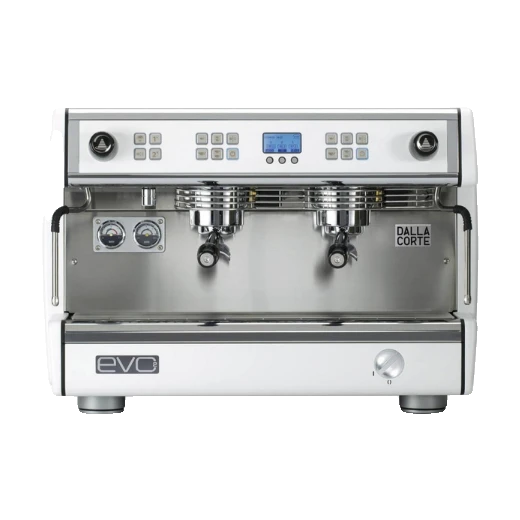
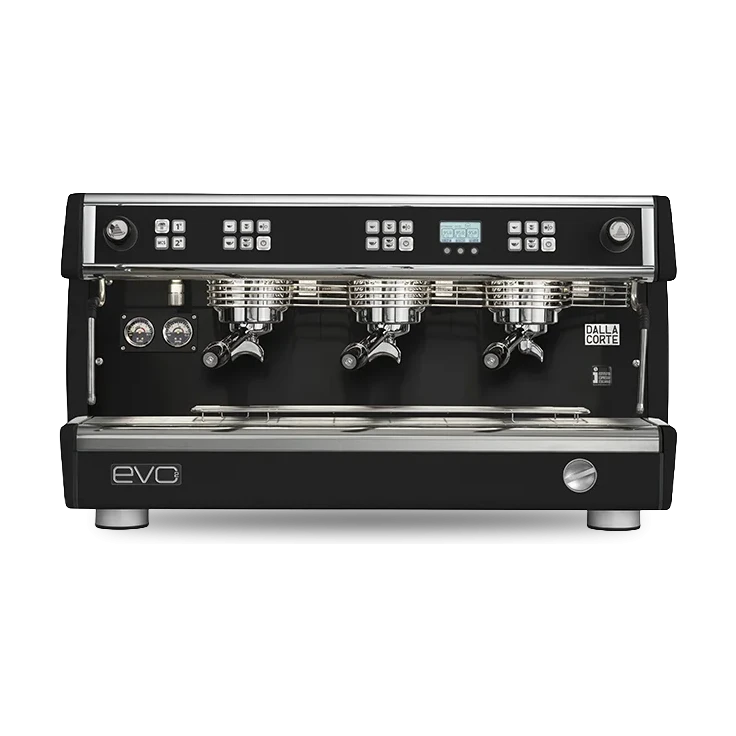
Dalla Corte · Workhorse traditional with independent group boilers
The Evo2 is Dalla Corte's workhorse: a traditional multi-group built for up to 500 shots a day. It keeps the brand's signature layout, a brew boiler with its own PID under every group plus a separate steam boiler, and trades the flagship extras for plain durability. High-volume cafes, restaurants, and hospitality programs run it daily, and on the bench it ages the way honest machines do: gaskets, cartridges, and scale before anything dramatic.
Why Grajqevci
Call in the morning and a technician is usually on-site before the day is out. Most Dalla Corte Evo2 jobs get diagnosed and fixed on the first visit.
Commercial coffee equipment is all we do, and Dalla Corte Evo2 is one of the platforms we know best. Not a generalist guessing at a service manual. Genuine OEM parts, industry-standard procedures.
Flat rate for the visit, with parts billed separately. For bigger jobs you'll see a written quote on-site before we proceed.
Skip the wait
Trusted by Toronto's most demanding teams






Evo2 faults we diagnose
Below are the Evo2 problems that generate real service calls, each listed with its usual cause and how we resolve it at the machine.
On a busy Evo2 this is standard wear at the 12-to-18-month mark. We replace the gaskets and dispersion screens and confirm a clean seal under pressure.
An oil-clogged dispersion screen is almost typically behind it. We fit a new screen and backflush the group with detergent until the pour evens out.
Solenoid wear or programming drift. We test the solenoid, recalibrate the profile through the service menu, and replace the valve if it's hesitating.
Pump wear or an expansion valve that has wandered. We gauge each group, adjust the expansion valve, and quote a pump replacement only if output measures below spec.
A worn rotary pump or inlet starvation makes the motor work harder than it should. We verify inlet pressure first, then inspect the pump itself.
Because each group has its own boiler system, a cold group isolates the fault to that group's NTC, PID, or element. We test all three, then replace the one the measurements condemn.
Scale, element wear, or pressurestat drift. We descale the boiler, test the element under load, and verify the pressurestat holds its setpoint.
Scale on the brew boiler elements stretches the morning warm-up. Each boiler gets descaled individually, and heat-up time is verified against spec afterwards.
We pressure-test the circuits, isolate the source, and replace the failed seals or fittings.
Undersized or blocked drain plumbing. We clear the line and recommend upsizing if your volume has outgrown the original run.
Routine wear. We rebuild the steam valve with the correct Dalla Corte cartridge and check for a dry shut-off.
The boiler can't recover fast enough, usually because of scale or a tired element. We descale, test the element, and confirm the pressurestat before the next rush proves it.
Flow meter buildup. We clean the meters, verify their pulse output, and reprogram the doses.
We diagnose whether the board or the UI module has failed and replace the right one, rather than guessing with parts.
Scale fools the probe into reading full. We descale or replace it and watch autofill behave before signing off.
Your coffee emergency ends here
Call or submit the form. We confirm your address, model, and the issue.
An experienced technician arrives, runs full diagnostics, and identifies the root cause.
You receive a flat, itemized quote. Nothing proceeds without your green light.
We complete the repair, run a test cycle, and walk you through what to watch for.
Parts on the truck
Track record
They've been our trusted partner for servicing espresso machines for years.
*Estimated based on the approximate distance from our nearest service centre, average commute time, and median service-call length for one machine. Prices in Canadian dollars (CAD $). Final quote provided on-site after diagnosis.
FAQ
20 answers covering service, repair, parts, installation, warranty, and edge cases.
Updated August 2026
Each group has its own boiler system, so a cold group means that group's NTC, PID, or element has failed. We test all three and replace the one the measurements condemn. The rest of the machine keeps serving in the meantime.
The steam boiler isn't recovering fast enough, and scale is the usual reason, with element wear and pressurestat drift behind the rest. We descale, test the element under load, and verify the pressurestat at setpoint. After that the boiler should hold through your busiest hour.
On a busy bar, every 12 to 18 months is normal. The first sign is weeping around the portafilter or a seal that needs muscle to lock in. We swap gaskets and dispersion screens together and prove the seal under brew pressure.
Yes, worth a look soon: a hot pump motor points at a worn rotary pump or a starved inlet. We verify the inlet pressure first, because a cheap plumbing fix beats a pump swap. If the pump itself is worn, you get the quote before we touch it.
Mineral buildup in the flow meters, nearly every time. We clean the meters, verify their pulse output, and reprogram dose-per-button. If it comes back within months, the water filtration needs attention, and we'll tell you that on the spot.
That's its rating, and plenty of the ones we look after live near it. The price of that pace is faster wear on gaskets, steam cartridges, and flow meters, plus scale arriving sooner on every boiler. The machines that hold up are the ones that get descaled on schedule.
Yes, all of them. The service vocabulary is identical across configurations: group boilers, steam boiler, pump pressure, flow meters, and group sealing. One platform, one parts kit, one visit.
Usually worth repairing. The platform is plainly built and parts move through the Dalla Corte/Franke network, so most repairs cost a small fraction of a new machine. When the math stops working, we say so and show you the numbers.
Flat rate for the visit, parts billed at their actual cost on top. You'll hear the rate when you book, and for bigger jobs we quote in writing on-site before any work starts. No estimate that balloons mid-job.
Same-day. Call in the morning and a technician is usually on-site before the day is out; calls placed later in the day book for the next morning. Urgent breakdowns get priority routing.
The GTA and most of the Golden Horseshoe: Toronto through Mississauga, Vaughan, and Markham, out to Oshawa, Hamilton, and Niagara. If you're not sure you're in range, call and we'll tell you straight.
No. We work call by call. Plenty of customers put us on a maintenance schedule eventually, but that's their choice after seeing the work, never a requirement.
Parts carry their manufacturer warranty, and we stand behind our labour: if the same fault recurs, call us and we'll review it. Specific terms are discussed upfront on each job, not promised in marketing copy.
On-site whenever possible, which is most of the time. If a job genuinely needs the bench, like a full boiler rebuild or major electronics work, we'll say so before anything leaves your building.
Call us or send the form on this page. We confirm the machine, the fault, and a time window the same day. If it's urgent, say so and we'll route the nearest technician.
Diagnosis first: we confirm the fault, tell you what caused it, and quote the fix before touching a wrench. Most repairs finish in that same visit because the common wear parts ride on the truck.
High-wear parts for the platforms we service constantly ride on the truck. Anything else we order, usually next-day where suppliers allow, and we tell you the lead time before committing you to anything.
Usually, yes. We service legacy machines for as long as parts can be sourced, and we're honest when a repair stops making financial sense against a replacement. You get the math, you make the call.
Often, but that's not the pitch. We quote against the actual work, not a factory pricing book, and we'll tell you when a manufacturer warranty claim is the better route. Transparency is the value; the price usually follows.
Yes, and we do it by default on the way out. Half of repeat faults trace back to skipped daily cleaning or wrong routine, so the technician walks your team through what actually matters before leaving.
Call the people who work on these machines for a living.
Call (289) 217-3796 now →